The Surface of the Sun

A Restless, Roiling Ocean of Fire
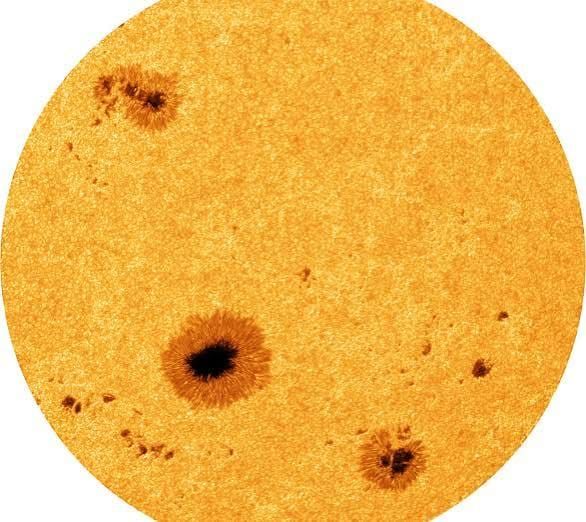
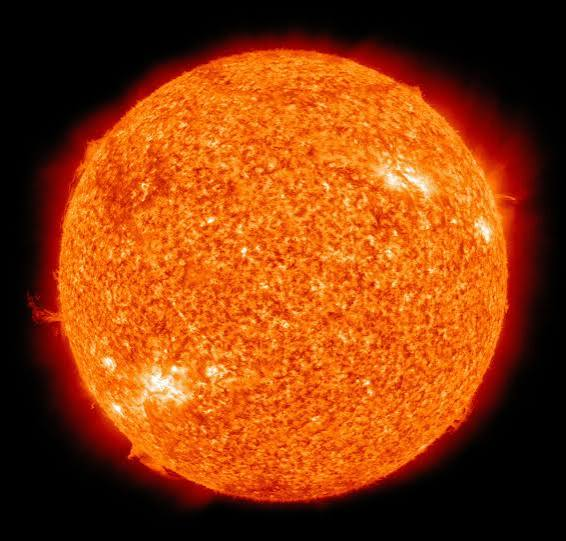
In order to understand space weather properly, we need to know about the surface of the Sun because that's where it all begins. Every flare, every eruption, every storm that eventually reaches Earth traces back to activity happening on this one restless layer. Yet the Sun's "surface" isn't solid ground the way it is for Earth or Mars. The Sun is a ball of plasma from core to corona, so what we actually see and call its surface is the photosphere — the visible layer where light finally escapes into space after being trapped and scattered for tens of thousands of years inside the Sun.
What Exactly Is the Photosphere?
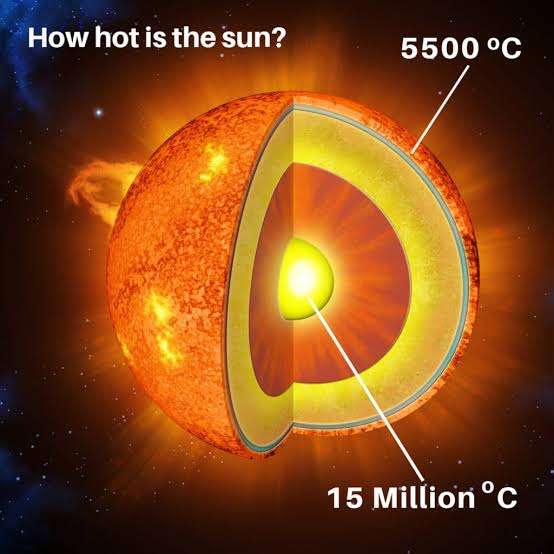
The photosphere is a thin shell, roughly 500 kilometres deep, sitting at the boundary where the Sun transitions from opaque to (relatively) transparent. Below it, plasma is so dense that photons can't travel far before being absorbed and re-emitted and therefore at the photosphere it thins out enough that light finally breaks free and streams outward, which is why this layer is what our eyes and telescopes actually register as the Sun's "edge."
Its average temperature sits around 5,500°C (9,900°F), though that number hides a lot of texture and turbulence up close.
A Boiling Sea of Granules
Zoom in on the photosphere with a solar telescope and it doesn't look smooth at all. It looks like the surface of a pot of boiling soup. This texture comes from granulation, small convection cells about 1,000 kilometres across, each one a bubble of hot plasma rising from below, spreading out, cooling and sinking back down. Individual granules last only 8 to 20 minutes before dissolving and reforming, driven by the constant churn of the Sun's convection zone just beneath the surface.
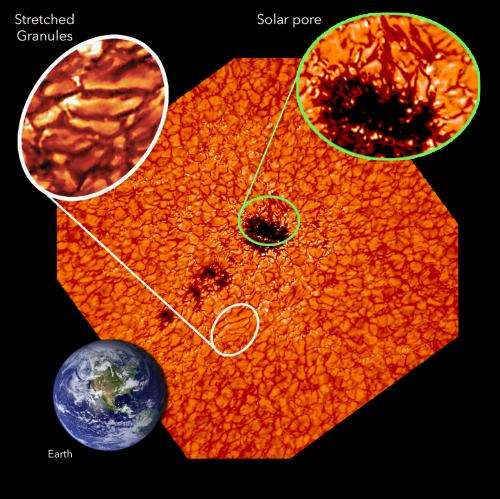
Larger structures called supergranules, spanning around 30,000 kilometres, organize the surface further, shaping how magnetic field lines get dragged and twisted across the Sun.
Sunspots: Where Magnetism Wins
The most famous surface features are sunspots, the dark blemishes that Carrington was sketching moments before his 1859 flare. Sunspots appear dark simply because they're cooler than their surroundings, typically around 3,500°C rather than 5,500°C, though "cooler" is relative; they'd still be blindingly bright on their own.
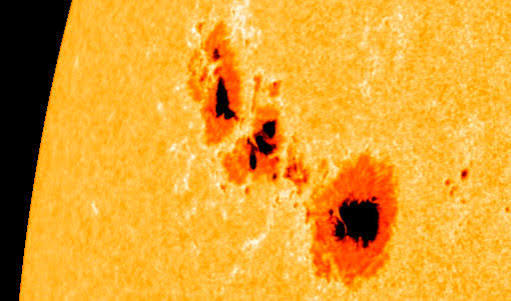
Sunspots form where intense magnetic field bundles punch through the photosphere, suppressing the convective flow that normally carries heat to the surface. They often appear in pairs or clusters with opposite magnetic polarities and their number rises and falls with the Sun's roughly 11-year solar cycle. More sunspots generally mean more flares and CMEs, which is exactly why solar physicists watch sunspot counts so closely.
Faculae and the Sun's Bright Side
Sunspots aren't the only magnetic features on the surface. Faculae are bright patches, slightly hotter than the surrounding photosphere, usually found near sunspot groups. They're harder to see against the Sun's already-bright disk but become more visible near the solar limb (edge), where our viewing angle lets us see into the "walls" of these elevated magnetic structures. Interestingly, faculae actually make the Sun very slightly brighter overall during periods of high sunspot activity, even though sunspots themselves are dark.
Why the Surface Matters for Space Weather
Everything that eventually threatens satellites, power grids and telecommunications on Earth starts right here, at this seemingly modest boundary layer. Sunspots mark twisted magnetic field regions capable of snapping and reconnecting violently, producing solar flares. Those same active regions can launch coronal mass ejections. Studying the photosphere in detail, its magnetic topology, its flows, its sunspot evolution, is how forecasters try to anticipate space weather days before it arrives at Earth.
In a curious way, the Sun’s visible surface is only the placid tip of a violently restless iceberg. Below it, a seething convection zone carries energy up from the core and above it, that same energy erupts into flares, wind and storms, and as the Carrington Event showed, their reach can extend all the way to Earth.