Why Aviation Radiation Can No Longer Be Ignored

A recent French verdict that has turned a known exposure into a legal question
Sophie Lainault joined Air France in 1989 as a flight attendant. In 2019, after more than 12,600 hours in the air, she was diagnosed with breast cancer. In July 2026, a court in Bayonne, France, recognised her illness as an occupational disease, reported as a first for a flight attendant in France. The judges did not blame a single cause. They weighed three exposures from her working life: night work, ionising radiation at altitude, and passive smoking in the cabin, which was still allowed on Air France aircraft until 2000.
Weeks later, a much larger picture arrived. Researchers led by Vishal Patel, of Harvard Medical School and Brigham and Women's Hospital, examined about 12.7 million US death certificates from 2020 to 2024, covering 503 occupations. Flight attendants ranked first for deaths from radiation-related cancers, at 6.9 per cent of their deaths, and pilots ranked second, at 6.7 per cent.
Two details make the result harder to dismiss. Aircrew sat near the median for cancers not linked to radiation, and aircraft mechanics, who work around planes but stay on the ground, showed no elevated rate.
For the industry, the ruling matters beyond one claim. Breast cancer is not listed in France's occupational disease tables, so Lainault had to establish a direct and essential link to her work, and two regional committees first found it unproven. The court accepted the combined exposure and noted no other genetic or lifestyle factor that explained the illness. Unless it is appealed, the decision is final, and reports say it may encourage other crew to bring similar claims. It also arrives ahead of an expert report from France's health agency ANSES, expected in autumn 2027, on breast cancer, night work and ionising radiation.
It puts dose monitoring in the spotlight too. France already estimates each crew member's dose flight by flight, using flight data supplied by airlines, and puts a Paris to Tokyo return at about 0.16 millisieverts. Air France told AFP that crew health and safety is an absolute priority and that its staff are followed beyond regulatory requirements. Where no such system exists, the question becomes who is tracking the dose at all.
Behind both the ruling and the study sits a physical question: what is this radiation, and where does it come from?
What is aviation radiation?
Aviation radiation is the ionising radiation coming from space that passengers and crew receive at cruising altitude. Ionising means each particle carries enough energy to knock electrons out of atoms, including the atoms in living cells. It is a stream of atomic nuclei, stripped of their electrons and travelling at close to the speed of light. In the cosmic rays that reach us from beyond the Sun, about 90 per cent are protons, around 9 per cent are helium nuclei, and the rest are heavier nuclei. They exist because the universe is full of natural particle accelerators. Exploding stars drive shock waves through space that hurl nuclei to enormous energies, and closer to home, the Sun does the same during flares and eruptions.
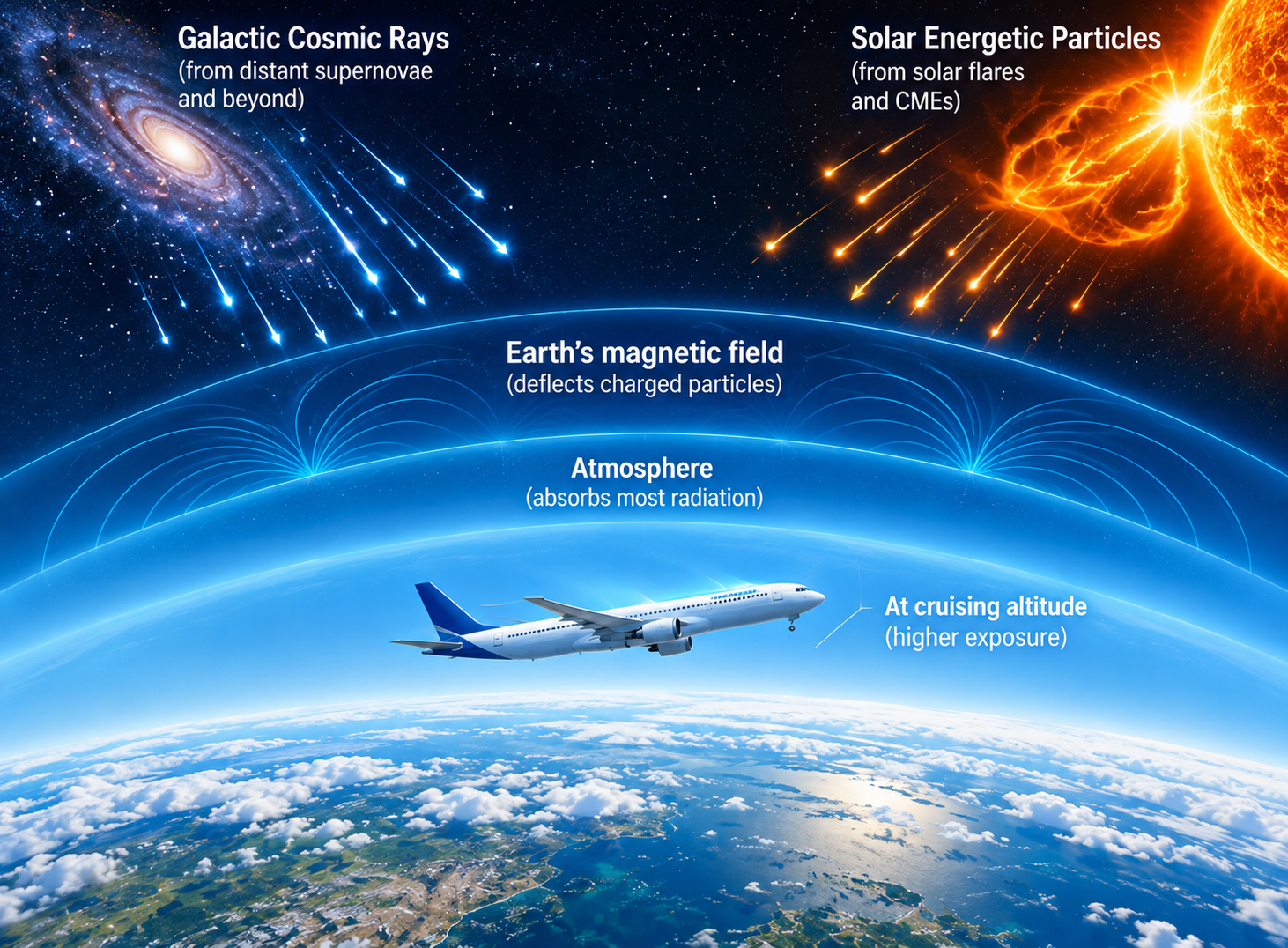
Two shields protect us on the ground, first is the Earth's magnetic field that deflects charged particles before they get near, and it decides how many can reach any part of the planet at all. The atmosphere is the second shield, and it absorbs most of what gets through. An aircraft at 10 to 13 kilometres is still inside the magnetic shield, but it has left a large share of the atmospheric one below it. The particles the magnetic field lets in meet less air, so more of them, and more of the secondary particles they create, reach the cabin.
Radiation sources
The radiation at flight altitude has two origins that behave almost like opposites.
Galactic cosmic rays (GCRs) are high energy particles, mostly protons, that arrive from outside our solar system, accelerated by distant supernovae and other violent events. They are always there. They do not care about the weather, the season or the time of day.
Solar energetic particles (SEPs) come from the Sun. They are accelerated during solar flares and coronal mass ejections, and they arrive in bursts that can last hours to days. Most events are modest. A few are intense enough to matter for aviation. The mechanics behind both drivers are covered under Solar Flares Explained and Coronal Mass Ejections Explained.
When either kind of particle strikes a nitrogen or oxygen nucleus in the upper atmosphere, it shatters it, and the fragments strike others. The result is a cascade of secondary particles, including neutrons, protons, muons and gamma rays. It is this shower, rather than the original particle, that an aircraft actually flies through.
The dose from this cascade increases with altitude up to roughly 15 to 20 kilometres, then declines. Commercial aircraft cruise on the rising part of that curve.
How much radiation are we talking about?
Radiation dose is measured in sieverts, a unit that expresses how much biological effect radiation has on the body. A microsievert is one millionth of a sievert, and a millisievert is one thousandth. For scale, the natural radiation everyone receives on the ground is roughly 2 to 3 millisieverts a year, or about 5 to 8 microsieverts a day.
On a typical long flight, the dose rate at cruising altitude is a few microsieverts per hour, with the exact figure depending on altitude, latitude and the point in the solar cycle. A long haul flight therefore delivers tens of microsieverts. The pilots' federation IFALPA lists about 90 for a Frankfurt to San Francisco flight, close to the dose of a chest X-ray.
For passengers, who fly occasionally, that is not a concern. For aircrew, who fly for a living, it adds up. Aircrew receive the largest average annual dose of any occupational group in the United States, according to the JAMA paper, and the US National Institute for Occupational Safety and Health puts individual annual doses between 0.2 and 5 millisieverts, depending on routes. IFALPA gives a similar 2 to 5 millisieverts. This is why aircrew are treated as occupationally exposed workers in many countries. For context, the International Commission on Radiological Protection recommends an occupational limit of 20 millisieverts per year averaged over five years, and 1 millisievert per year for the general public.
So the honest summary is this: routine exposure is low and well within limits for most travellers; it is the frequent flyers and the crew who deserve attention, and the rare solar event that deserves vigilance.
Why Geographical latitude matters
Earth's magnetic field acts like a filter, and it is not equally strong everywhere. Near the equator, the field lines run roughly parallel to the surface and turn away all but the most energetic particles. Near the poles, the field lines plunge into the atmosphere, leaving a door open for far more particles to enter.
The practical result is that dose rates at high latitudes are noticeably higher than at low latitudes at the same altitude. At typical flight altitudes, the Health Physics Society puts the difference between the equator and high latitudes at a factor of two to three. Data from Germany's Federal Office for Radiation Protection, reported by Aviation Week, show about 6 to 7 microsieverts per hour at 36,000 feet over Hudson Bay, against 2 to 3 over Florida or southern California. A flight that stays near the equator receives less than one that crosses the North Atlantic or flies a polar route. Geography decides again.
The solar cycle twist
Here is the part that surprises people. Galactic cosmic rays are weaker at solar maximum, yes weaker! An active Sun carries a stronger, more tangled magnetic field outward through the solar system, and that field pushes some galactic particles away before they reach Earth. At solar minimum the shield relaxes and the galactic dose rises. So when the Sun is at its most active, the steady background dose drops, while the risk of a sudden solar particle event climbs.
We are now in the solar maximum range of Solar Cycle 25, which makes that second risk the one to watch. The most extreme of these events are ground level enhancements (GLEs), when a flare or CME accelerates particles to energies high enough to raise radiation levels even at ground level. The largest, in February 1956, sent radiation at flight altitudes far above normal. The current cycle has already produced one, on 28 October 2021, when an X1 class flare triggered a modest but unmistakable GLE.
For aviation, the concern is a short window of sharply elevated dose, most significant on high latitude routes. The options are practical: fly lower, since dose falls with altitude, or reroute away from high latitudes. Both cost fuel and time, which is why the decision depends on timely, reliable information.
Inside the Aviation Radiation Advisory System
Since November 2019, the International Civil Aviation Organization (ICAO) has required space weather advisory services for international air navigation, covering radiation alongside GNSS disruption and HF communications. Designated global centres issue advisories, and for radiation, an advisory is raised when the effective dose rate at flight level reaches moderate (30 microsieverts per hour) or severe (80 microsieverts per hour) thresholds.
The advisories travel through the aviation community's own channels. They are routed as standard messages over the aeronautical fixed telecommunications network, the same way routine weather messages are, and they are also available through the secure aviation weather services SADIS and WIFS (ICAO, PECASUS). From there they are passed to operators and flight crew, for whom they are mandatory briefing information. For Africa, the South African National Space Agency (SANSA) is the ICAO designated regional centre, supporting the four global centres.
That gives airlines and air traffic managers a common language for decisions. It does not remove the need for regional capability.
Why this matters for Africa
African carriers fly long haul routes to Europe, the Middle East, Asia and the Americas, and every one of those flights spends time at altitude where the dose is real. These flights start near the equator, where the magnetic shield is strongest, and the dose rate climbs as they head north.
The advisories exist. What is less clear is what happens next. Do airline operations and air navigation providers across the continent receive radiation advisories and know how to act on them? Are crew doses estimated and recorded, with tools such as the US FAA's CARI program? Is there a plan for flight levels and routes when a large solar particle event is under way? SANSA is the only African centre designated by ICAO, so every other state on the continent relies on advisories issued from outside its borders. A continent that depends on aviation for trade, tourism and connection should settle these questions before the next large solar particle event, not after.
We have known about this radiation for decades. The task now is to measure it, record it and plan for it, before a court, a study or a storm forces the question.