Can Atmospheric Drag Keep Low Earth Orbit Clean in the Age of Mega-Constellations and Space Weather?

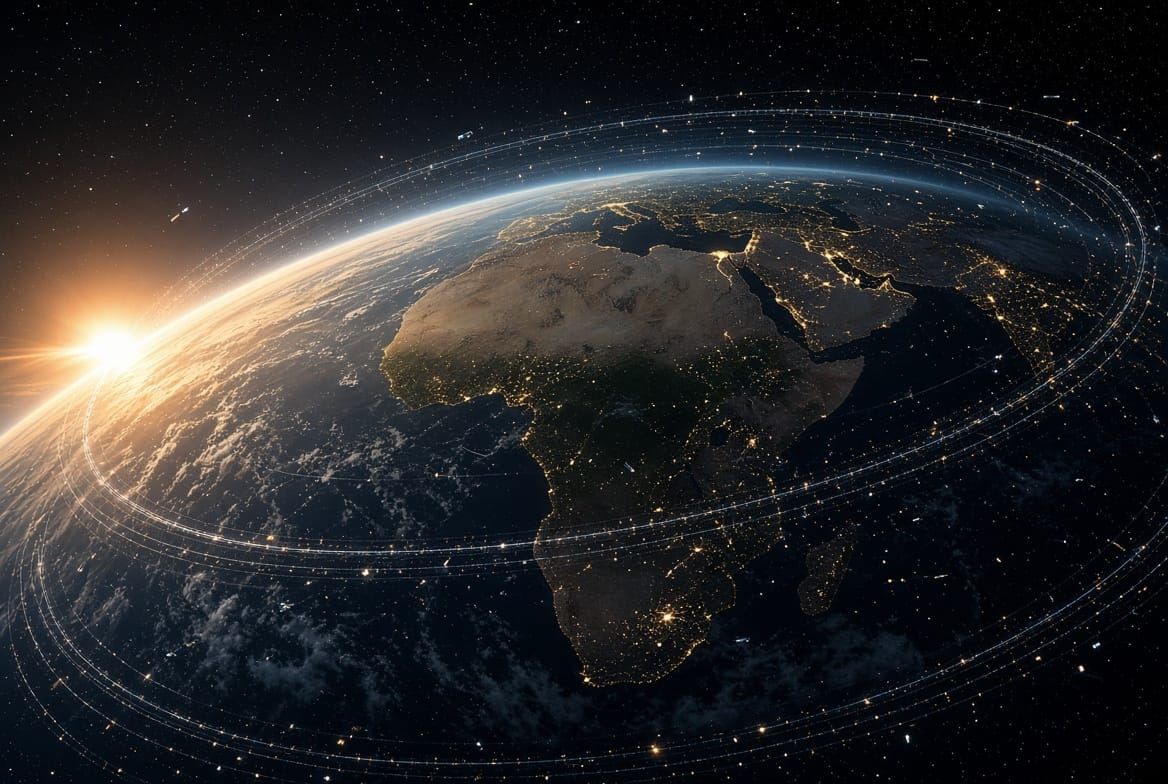
Low Earth orbit (LEO) is undergoing the most rapid transformation in its history. What was once a relatively sparse region of space, home to only a few thousand active satellites and debris objects, is now filling with tens of thousands of spacecraft. This shift has been driven by mega-constellations, large fleets designed for global broadband, Earth observation, and emerging uses such as orbital data centres. SpaceX’s Starlink accounts for the majority of active satellites, while other major systems, including Eutelsat’s OneWeb, Amazon’s Kuiper, China’s Guowang (SatNet), and the commercial Qianfan (G60/Spacesail) constellation, continue to add significant density.
In as much as this proliferation delivers clear benefits, such as lower-latency internet, improved Earth monitoring, and new commercial opportunities, it also creates intense orbital crowding. The resulting environment raises fundamental questions about sustainability, particularly the interplay between atmospheric drag (the aerodynamic resistance force that acts on objects moving through the upper atmosphere, causing them to lose orbital energy and gradually decay) and the collision risks that grow with density. When collisions generate debris faster than drag can clear it, the system can tip into instability. Recent analyses show that several planned and partial deployments already approach or exceed critical thresholds for runaway debris growth.
The Big Question
The question this article asks is whether atmospheric drag, the only natural cleanup system in low Earth orbit, can keep up. This matters well beyond the major space powers: Africa depends on others for tracking and cannot independently verify conjunction warnings, so how well drag works, and how space weather affects it, shapes the continent’s risk. The short answer is only partly: drag clears debris effectively at low altitudes under predictable conditions, but it weakens higher up and swings with space weather, while mega-constellations push orbits toward the point where debris is created faster than drag can clear it.
Orbital Crowding and Rising Stress Indicators
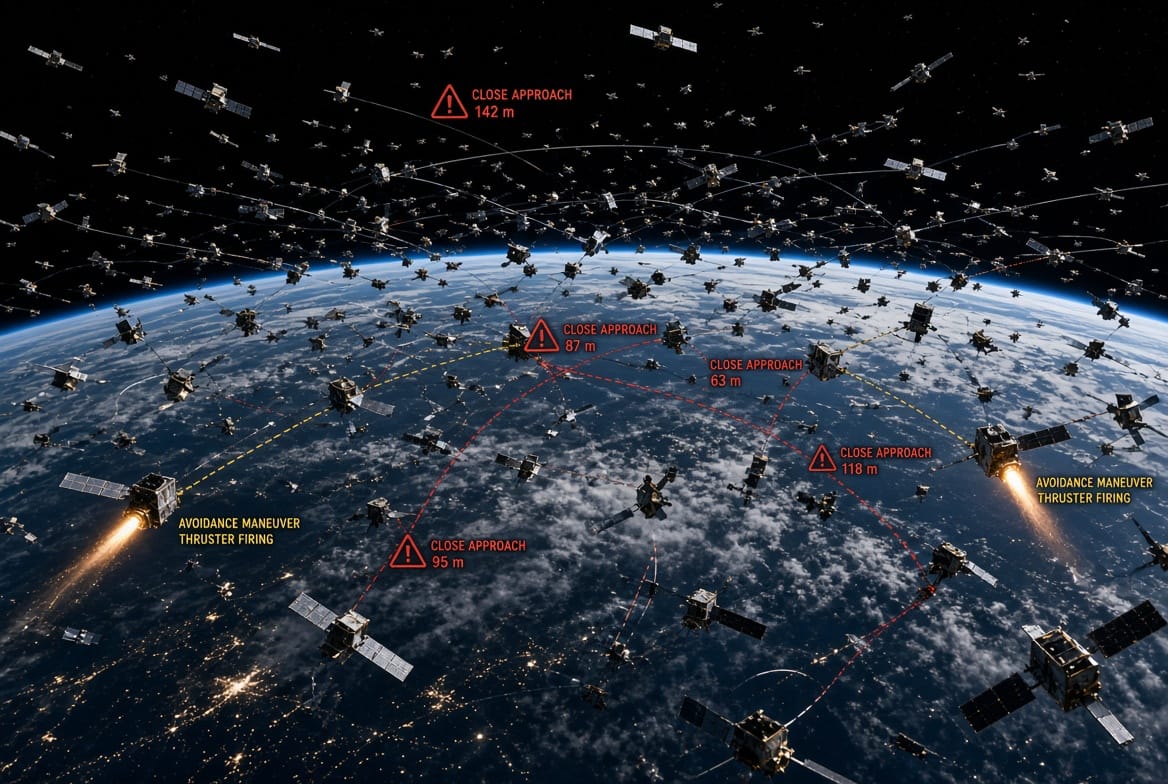
To judge whether drag can keep up, we first need to see how much it is being asked to clear. Mega-constellations concentrate large numbers of satellites into relatively narrow altitude bands, typically between 400 and 600 km for many broadband systems, with others at higher altitudes. This creates unprecedented spatial densities, and in such crowded shells, close approaches, or conjunctions, have become routine: across all LEO mega-constellations, satellites now pass within 1 km of each other about every 22 seconds. One metric that captures this growing pressure is the CRASH Clock, which estimates the average time between potential high-risk conjunctions in the absence of avoidance maneuvers. It has fallen from roughly 164 days in 2018 to just a few days in recent catalogs, reflecting the sharp increase in object numbers and interaction rates.
Maneuver rates have scaled accordingly. Operators of large constellations perform frequent collision-avoidance burns, and Starlink alone made roughly 300,000 in 2025. In dense shells these local decisions can cascade, meaning a maneuver by one satellite to avoid an external object may increase risk for its neighbors, prompting further maneuvers. Studies of self-driving mega-constellations highlight this amplification effect, where external conjunctions trigger dozens of internal responses.
Crowding is not uniform. Satellites tend to cluster in a few preferred altitude shells, which turns those bands into bottlenecks. Above roughly 600 to 800 km, debris models already show signs of long-term instability, because the air is so thin that drag is much weaker and debris stays in orbit for far longer. Even the main Starlink shell near 550 km, where drag clears debris more quickly, sits near or within runaway thresholds under some assessments once satellite surface area and density are considered. A runaway threshold is the point at which collisions create debris faster than drag can remove it.
Atmospheric Drag: Cleanup Mechanism and Vulnerability
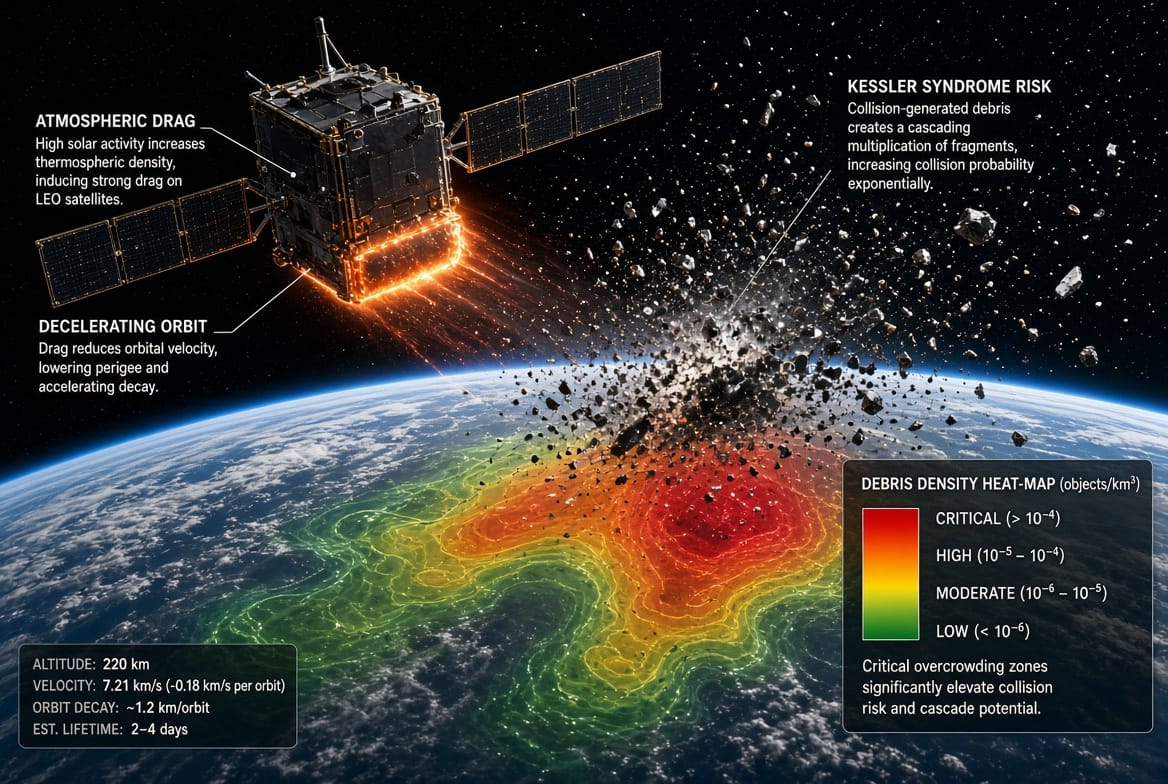
If crowding keeps rising, the question becomes how much debris drag can actually remove. Atmospheric drag is the dominant natural sink for objects in LEO. At 400 km, most objects decay within months to a few years. Near 550 km, lifetimes for large objects extend to roughly five years (longer for denser fragments). Above 800 km, residual lifetimes can stretch to decades or centuries. Drag therefore acts as a planetary cleaning service, but only effectively at lower altitudes and under favorable solar conditions.
Solar activity and geomagnetic storms modulate this process dramatically. Increased solar flux heats and expands the thermosphere, raising density and accelerating decay. This can be beneficial for clearing debris but operationally disruptive: newly launched satellites in low staging orbits have been lost during storms when drag exceeded predictions. The same variability complicates long-term planning for constellation lifetimes and disposal.
In the context of crowding, drag’s role becomes double-edged. While it removes failed satellites and fragments, the rate of removal is finite. Collision rates scale with the product of object density and cross-sectional area. When the production of fragments (driven by density and the number of fragments per collision) exceeds the drag sink rate, the population grows. This is the classic condition for Kessler–Cour-Palais Syndrome: a self-sustaining cascade in which debris generation outpaces removal.
Recent analytical work formalises this balance through a collision reproduction number, borrowed from epidemiology, where the logic is the same: a disease keeps spreading when each infected person passes it to more than one other person, and orbital debris becomes self-sustaining when each collision produces enough fragments to cause more than one further collision. For a representative 550 km shell, the transition to instability often corresponds to a population on the order of 20,000 satellites, under standard assumptions about how many fragments a collision creates, how fast objects move relative to each other, and how quickly drag removes debris. Above roughly 38,000 satellites without aggressive mitigation, the system enters a dynamically unstable regime, where debris is created faster than it can be cleared. At higher altitudes, or with larger satellites, these critical numbers fall, because thinner air means drag removes debris more slowly
Critical Sizes and Runaway Risks
With drag’s limits in mind, the next question is how large a constellation can grow before debris creation outpaces it. A 2026 analysis by Hugh G. Lewis tested 16 major planned or operational constellations, totaling nearly 1.7 million satellites, using a modified stability model. The model updates the classic framework of Kessler and Anz-Meador to include active collision avoidance, satellite replenishment, and realistic drag profiles. Several systems, including large Chinese networks, certain high-altitude proposals, and extreme concepts such as million-satellite orbital data centers, exceed the critical size for runaway fragment growth, meaning the debris would multiply on its own, even when each is evaluated in isolation and under optimistic mitigation assumptions. Others settle into unstable equilibria, balance points that a small disturbance can tip into runaway growth. Even smaller constellations at higher altitudes can cross these thresholds, because debris lingers far longer where drag is weak.
These findings underscore that size alone is not the sole driver. Altitude, satellite design (area-to-mass ratio), operational lifetime, disposal reliability, and collision-avoidance performance all influence the outcome. Lower operating altitudes leverage stronger drag for faster cleanup. Designs that intentionally increase drag at end-of-life, longer operational lives that reduce replenishment traffic, and high post-mission disposal success rates expand the safe parameter space.
Holistic lifecycle models that incorporate deployment, operations, failures, and disposal similarly show that “safe space” regions exist in the multi-dimensional parameter space of constellation number, orbit choice, satellite design, and practices. Poor choices, however, can shorten the mean time to a self-sustaining cascade.
Differential Drag as a Control and Mitigation Tool
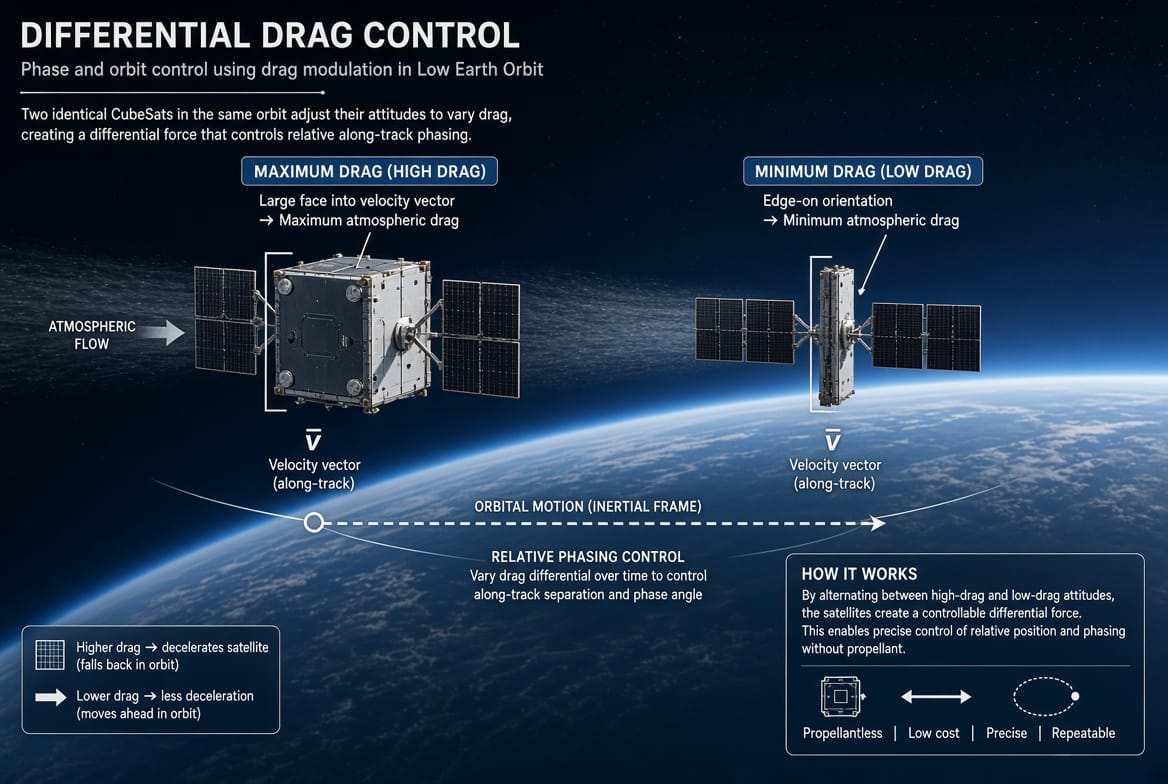
Drag is not only a cleanup mechanism but also a control tool, which makes its sensitivity to space weather matter even more. Differential drag techniques change a satellite’s attitude or deployable surfaces to alter how much drag it feels, allowing relative phasing and station-keeping without thrusters. Planet Labs demonstrated this operationally with its Flock CubeSat constellations, and the approach is also studied for collision avoidance on small satellites and for deploying a constellation from a single launch. Drag-augmentation devices, such as sails, help satellites deorbit passively at the end of their mission. The trade-off is that all of these methods rely on atmospheric density, which is hard to predict, so the same variability that complicates debris cleanup also limits drag-based control.
Implications for Africa’s Space Situational Awareness and Space Weather
Drag’s limits, and the space weather that controls them, bear directly on Africa. The continent’s reliance on space systems is growing, and so is its exposure to crowding, drag, and debris. Countries such as Egypt, Nigeria, South Africa, and Algeria operate satellites for Earth observation, communications, and security, yet the continent still holds a small share of global satellites and has no large independent tracking infrastructure.
Space situational awareness (SSA) capacity is still limited. South Africa’s optical tracking assets and ground stations, along with partnerships in Nigeria, Algeria, and Egypt, offer only partial coverage, so most operators depend on international data sharing for conjunction assessment and catalog maintenance. As mega-constellations increase the number of close approaches, African satellites face higher collision risk and the continent has few independent means to verify or challenge external conjunction warnings.
Space weather compounds the problem. During storms, thermospheric density can rise several-fold, which increases drag, speeds up orbital decay, and makes satellite positions harder to predict, exactly when maneuver decisions are most urgent. For African LEO satellites and future constellations, this complicates lifetime predictions, station-keeping budgets, and collision-avoidance planning. Much of Africa also lies under the equatorial ionization anomaly, where ionospheric scintillation and variations in total electron content already degrade GNSS and communication signals. This makes monitoring these conditions across the continent essential.
Building resilient African SSA and space weather capacity calls for stronger regional monitoring networks, data-sharing agreements that give operators timely access to high-fidelity catalogs, training in orbit determination and conjunction assessment, and the integration of space weather products into satellite operations. These steps apply whether Africa expands through national satellites, continental coordination under the African Space Agency, or participation in global traffic management.
Conclusion
Can atmospheric drag keep low Earth orbit clean? Only within limits. It clears debris reliably at low altitudes and under predictable solar conditions, but it weakens higher up, varies with space weather, and removes debris at a finite rate that dense constellations can outpace. The safe margin therefore depends on how well drag can be predicted, which makes space weather monitoring part of orbital safety, particularly for Africa, which has the fewest independent means to track and verify the risk.