Coronal Mass Ejections (CMEs) Explained

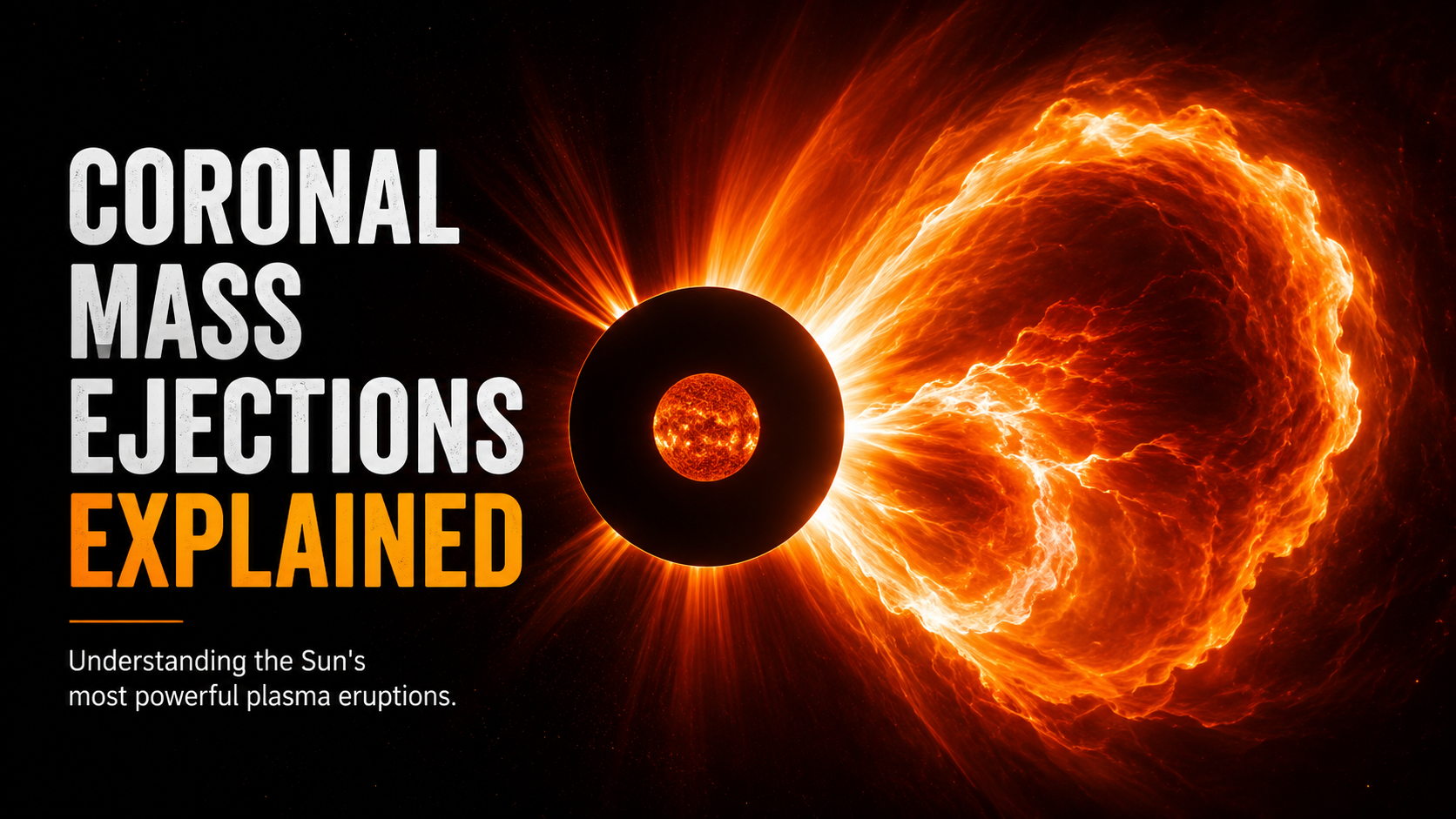
Not every eruption from the Sun is made only of radiation. Some are made of matter. When the Sun ejects billions of tonnes of its own material into space, we call it a coronal mass ejection, or CME. Most of the time this cloud drifts off harmlessly in some other direction. But when it happens to be aimed at us, it becomes one of the most disruptive events our space dependent technology can face.
What is a Coronal Mass Ejection?
A coronal mass ejection is a massive expulsion of plasma from the Sun's outer atmosphere, called the corona. Plasma here simply means a cloud of electrically charged particles, electrons and ions, stripped apart from the Sun's corona. This plasma originates from the Sun's magnetised interior, it thus carries a magnetic field along with it as it is flung outward.
Whereas a solar flare is a burst of radiation only, meaning energy alone with no physical material involved, a CME is a physical cloud of solar material thrown outward into space. The two are related but distinct. Flares release energy. CMEs release mass.
CMEs form in the same active regions (sunspot regions), that produce solar flares. As discussed in Solar Flares Explained and Sunspots Explained, active regions are areas where concentrated, powerful magnetic fields from the Sun's interior force their way upward and break through the Sun's surface. When those field lines snap and reconnect, they release energy in the form of a solar flare. When that reconnection happens beneath a twisted rope of magnetic field holding plasma above it, and the eruption is powerful enough to break that rope free entirely rather than simply snapping back into place, it flings the surrounding plasma, the material trapped within the magnetic loops, outward into space. That ejected material is no longer a beam or a flash like a flare. It is a cloud, often billions of tonnes of plasma, expanding as it moves away from the Sun. This expanding cloud is the coronal mass ejection.
A single CME can grow larger in size than the Sun itself by the time it reaches the Earth. It expands simply because it is moving outward into the ever-widening volume of space, spreading the same way smoke spreads as it rises and disperses. This means the further it travels, the more it grows in size even as it thins out in density.
The CME carries its own magnetic field within it, and the strength and direction of that field is what decides how disruptive the CME becomes on arrival, both how severe the impact is and which systems end up affected. What that field does on arrival is explained fully below.
How fast do they travel and how long until they reach Earth?
Unlike a solar flare's radiation, which moves at the speed of light and reaches Earth in about eight minutes, a CME is a physical material and thus, cannot travel that fast. CME speeds vary considerably depending on the strength of the eruption that launched them. A more energetic magnetic reconnection event releases more energy into the ejected plasma, producing a faster CME. A weaker reconnection produces a slower one. The slowest CMEs drift outward at a few hundred kilometres per second. The fastest ones, associated with the most powerful eruptions, have been recorded moving at up to 3,000 kilometres per second.
That difference in speed translates into a real difference in warning time of its Effects on Earth. A slow CME can take three to five days to reach Earth. A fast, powerful one can arrive in as little as 15 to 18 hours. This is the window that matters most for space weather forecasters. Unlike a flare, where the only option is to brace for an effect already on its way, a CME gives operators actual advance notice, sometimes days of it, to prepare. In practice, this preparation can look like satellite operators powering down non-essential systems or adjusting orientation to counter CME-induced drag, power grid operators managing load to protect transformers, and airlines rerouting flights away from polar paths where the disturbance is felt most.
Not every CME is heading for Earth. Because they erupt from a specific point on the Sun's surface and travel outward in a fairly defined direction, only those aimed roughly toward us have any effect on us. A CME launched from a region facing away from Earth, or from a point on the Sun that has since rotated out of view, may be enormous and still miss us entirely.
How do we track and forecast a CME's arrival?
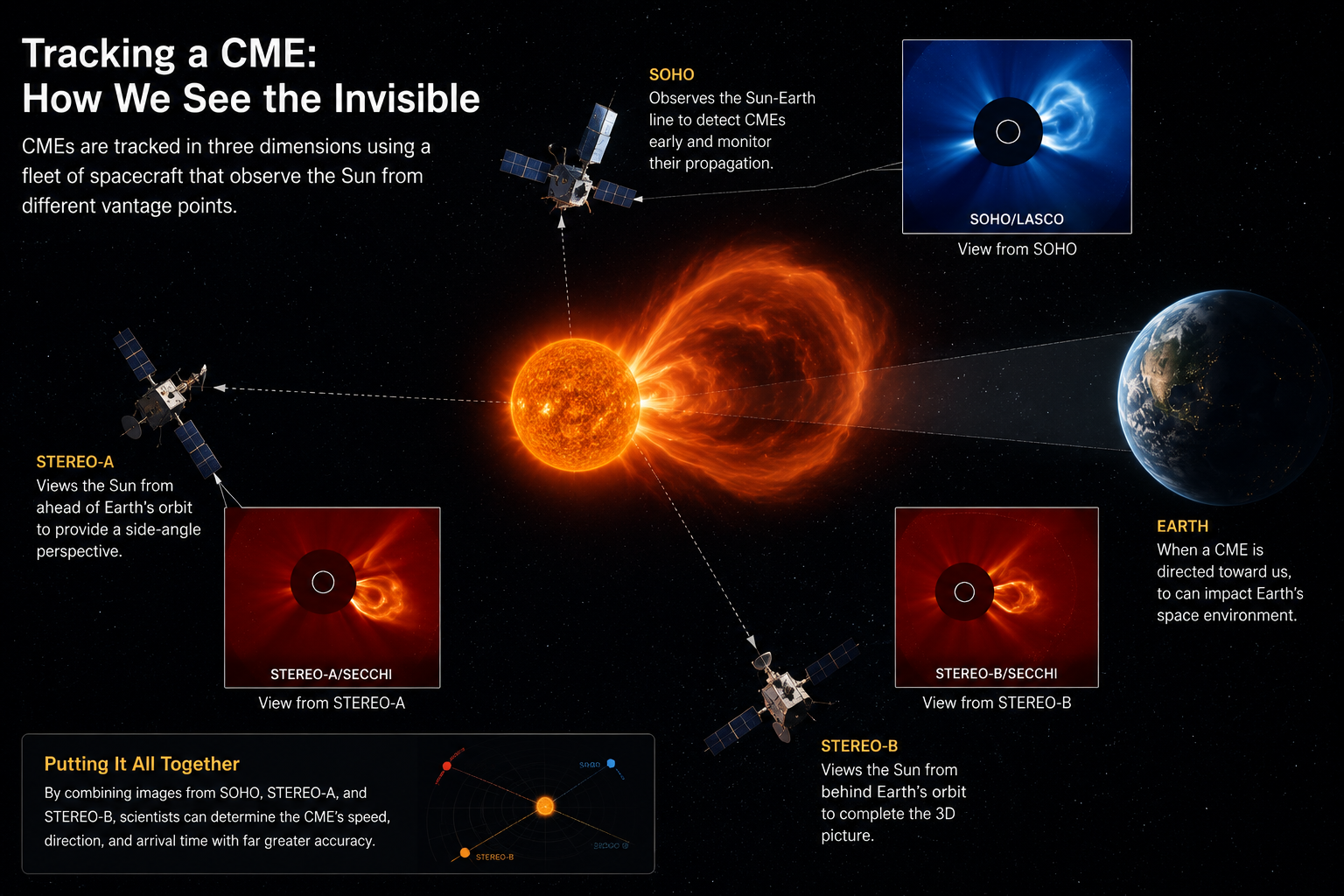
Because a CME takes hours to days to arrive rather than minutes, forecasters have time to actually watch it coming. This is done using instruments called coronagraphs, which block out the Sun's overwhelming brightness so that the much fainter corona around it becomes visible, allowing the outward moving cloud of plasma to be observed directly. One of the key tools for this is NASA's STEREO mission, a twin spacecraft positioned to view the Sun from different angles, giving forecasters a three-dimensional view of a CME's shape, speed, and trajectory rather than a single flat image.
By tracking how far the leading edge of the cloud moves between images and how much time has passed, forecasters calculate its speed and estimate when it will reach Earth, along with how directly it is likely to strike. This is what allows a space weather warning to be issued days in advance rather than only after it has already arrived.
What happens when they arrive?
When a CME reaches Earth, it does not pass by unnoticed. It collides with Earth's magnetosphere, the magnetic bubble surrounding our planet, generated by Earth's own magnetic core, that normally shields us from the constant stream of solar wind. Without this shield, that steady flow of charged particles from the Sun would batter our atmosphere directly and expose satellites and astronauts to far harsher conditions than they experience today.
The CME's magnetic field, meaning the field lines carried within its plasma as it travels, is the deciding factor in what happens next. Earth's own magnetic field points in a fixed direction, and the CME's field can arrive oriented either the same way or the opposite way. If the CME's field points opposite to Earth's, the two fields connect in a process called reconnection. Picture this reconnection as tearing open a gap in Earth's magnetic shield. Through that gap, solar plasma and energy pour directly into the magnetosphere and funnel down along the newly joined field lines toward the polar regions of the earth’s atmosphere, far more efficiently than the shield would normally allow. If instead the CME's field points the same way as Earth's, the two fields resist connecting, and much of the incoming energy is deflected around the magnetosphere entirely, the way water flows around a rock rather than through it. In that case, the effects on Earth are comparatively mild, often limited to little or no disruption to technology.
Geomagnetic Storms Introduced
When reconnection does occur and energy pours in, the result is what we call a geomagnetic storm, the name given to this large scale disturbance of the magnetosphere. The first and most visible effect is the aurora. As the incoming charged particles funnel down toward the poles, they collide with oxygen and nitrogen atoms in the upper atmosphere, exciting them and causing them to glow, which is what produces the beautiful aurora borealis and aurora australis. Beyond the visible display, the compressing magnetosphere also drives strong electric currents in the upper atmosphere, as the moving charged particles themselves constitute an electric current sweeping through that region.
These currents and the disturbed electric conditions they create go on to affect satellite operations, GNSS accuracy, HF radio communication, and power grids, each in its own distinct way. How severe any of this becomes also depends on factors such as the time of day the storm hits and the exact strength and direction of the CME's field. Each of these effects, and what drives their variability, is covered in full in Coronal Mass Ejections (CMEs) Effects on Space Dependent Technologies.