Coronal Mass Ejections (CMEs) Effects on Space Dependent Technologies

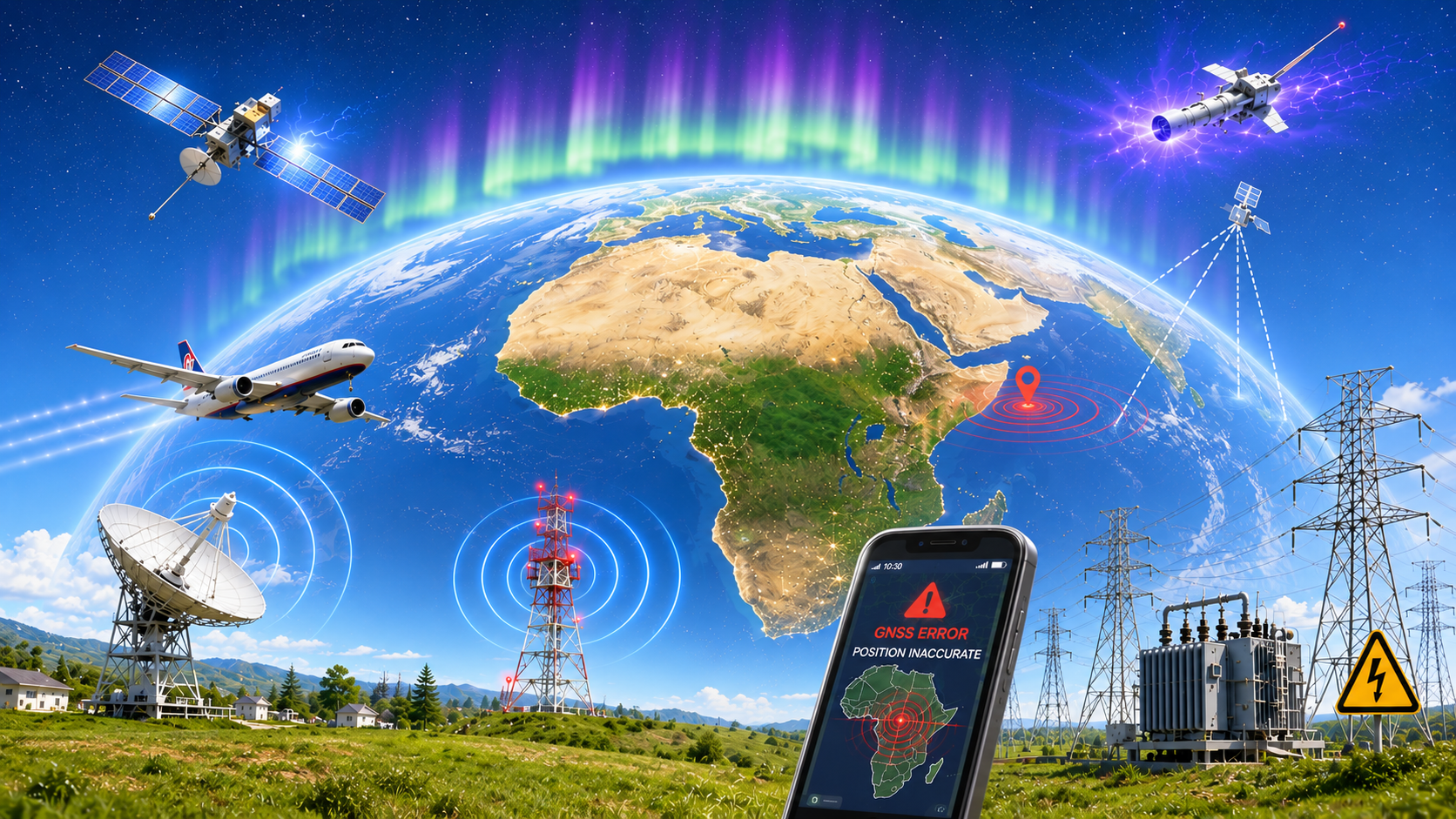
A coronal mass ejection does not damage anything by itself simply travelling through space. It has to arrive, collide with Earth's magnetosphere, and hand off its energy by linking its own magnetic field to the Earth's magnetic field before any real effect begins, and that handoff is what we call a geomagnetic storm. In other words, a geomagnetic storm is not a separate event from a CME. It is the CME's impact, the moment its journey through space actually becomes something we feel.
A geomagnetic storm does not attack one system and leave the rest alone. It reaches into orbit, into the ionosphere, into the ground itself, disturbing each in its own way and on its own timeline. What follows is what that disturbance actually looks like, system by system, and we are going to explore each one in turn, starting with the part of the storm we can actually see with our own eyes.
Auroras: The Prettiest Side of a Geomagnetic Storm
When a CME's magnetic field connects with Earth's own field, as covered in Coronal Mass Ejections Explained, charged particles from the CME funnel down along Earth's magnetic field lines toward the polar regions rather than striking the whole planet at once. As these particles descend into the upper atmosphere, they collide with oxygen and nitrogen atoms already present there. Each collision transfers energy into the atom, exciting it briefly, and when the atom settles back down it releases that energy as a small burst of light. Multiply this by billions of collisions happening at once, and the result is the aurora, the glowing curtains of green, red, and purple light seen in the sky at high latitudes. Oxygen tends to produce green and red light depending on altitude, while nitrogen tends to produce blue and purple. During a strong enough storm, this glow can stretch far beyond its usual polar range, which is why an aurora is sometimes visible at surprisingly low latitudes during a major event, e.g. the 2024 Mother's day super storm
The aurora is the visible signature of the storm, but it is also the first clue that the same particles and currents driving that glow are, at that same moment, reaching into the systems covered below.
How do CMEs affect satellites?
The first thing a satellite feels during a geomagnetic storm is drag. Energy pouring into the upper atmosphere heats it, and heated air expands upward and outward, reaching altitudes it would not normally occupy. Satellites in low Earth orbit, which sit within this expanded region, suddenly encounter far more atmospheric density than their orbit was calculated for. That added density pulls against the satellite, slowing it down and dragging it toward a lower altitude than planned. Left uncorrected, this drag can shift a satellite's position enough to throw off its orbit entirely, so operators must fire thrusters or adjust orientation to compensate and keep the satellite where it belongs. This is exactly what happened in February 2022, when a moderate geomagnetic storm increased atmospheric drag enough to pull down 38 newly launched Starlink satellites before they could reach a stable orbit, destroying them on reentry.
There is also a more direct electrical effect. The storm's disturbed magnetosphere means the charged particle environment around a satellite changes rapidly and unevenly. Different parts of the satellite's surface can accumulate different electrical charges, and when that imbalance becomes large enough, it discharges suddenly, similar to a static shock. That discharge can damage sensitive onboard electronics or, at minimum, cause temporary glitches in the satellite's systems.
How do CMEs affect GNSS accuracy?
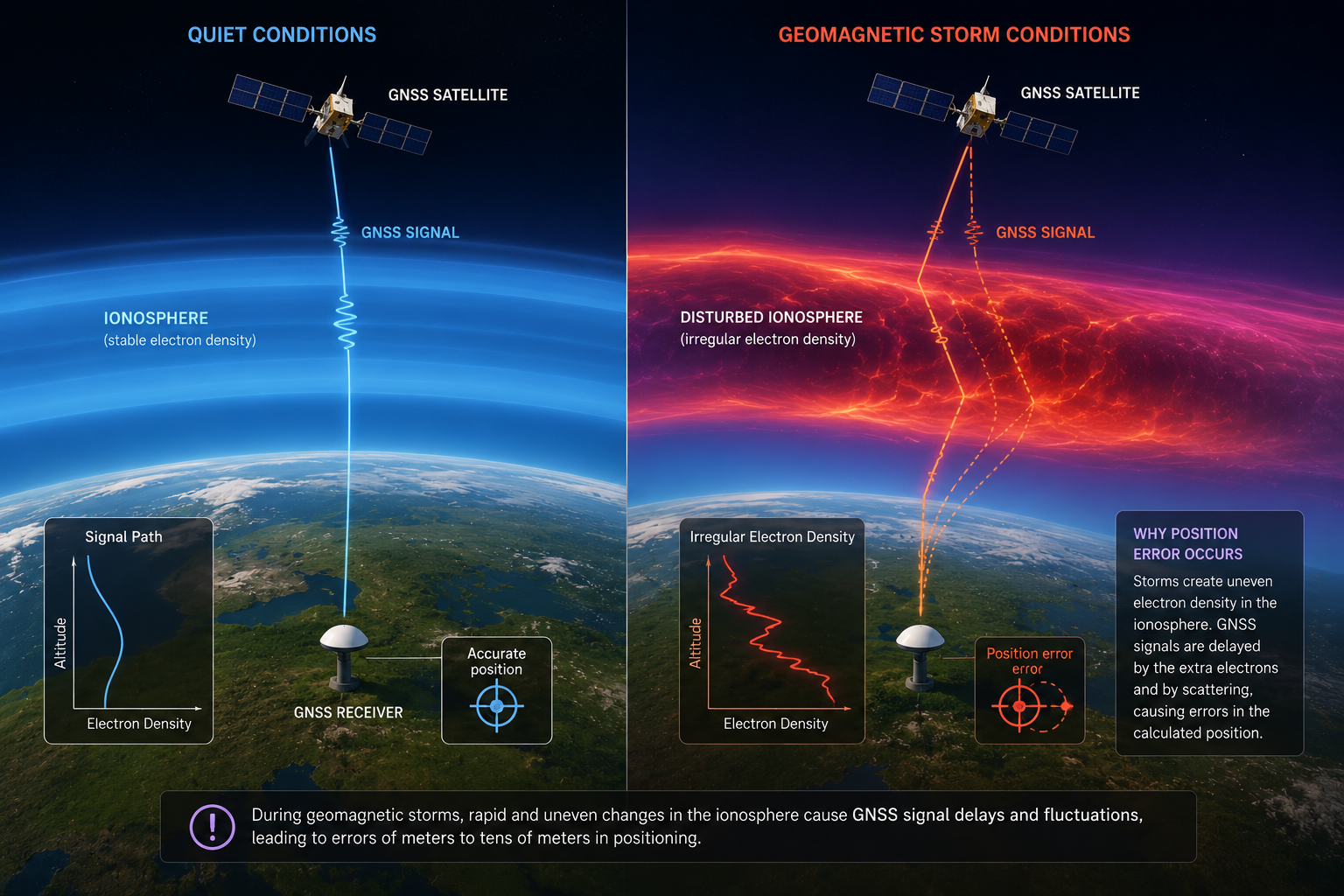
GNSS systems, such as GPS, calculate a receiver's position by timing how long a signal takes to travel from satellite to ground. That calculation assumes the signal passes through the ionosphere at a known, expected rate. A geomagnetic storm removes that assumption, since the storm reshapes the ionosphere's electron density broadly and for days at a time, and that reshaping is anything but uniform. Some regions see a sharp increase in electron density, others see a sharp decrease, and the boundaries between these regions can be sharp and fast moving.
Every extra electron the signal passes through delays it slightly, because the signal loses a small amount of energy interacting with each free electron along its path, and that accumulated interaction slows its effective travel time. Beyond this broad delay, the storm can also trigger scintillation which refers to the rapid, irregular fluctuations in a signal's strength and phase. Unlike the broad delay that shifts a position calculation steadily off course, scintillation causes the signal to flicker and drop unpredictably, sometimes causing the receiver to lose the satellite's signal completely (loss of lock). That unpredictability is what makes scintillation the single greatest GNSS concern for low latitude regions (the zone that includes most of Africa), where it occurs most often. A broad, steady delay can at least be modelled and corrected for. A signal flickering in and out cannot.
What makes this worth separating from the rest of storm driven effects is that scintillation is not only a storm phenomenon. It is a regular feature of the low latitude ionosphere even on quiet, non-storm days, driven by the ionospheric plasma irregularities that form after sunset. This occurrence becomes more common and more intense during periods of high solar activity and during certain seasons, particularly around the equinox months. A geomagnetic storm, then, does not create this vulnerability. It can either enhance it, making scintillation stronger and more widespread than usual, or in some cases suppress it, depending on the storm's timing and characteristics.
When either of these effects changes faster than the receiver's model can account for, the position it calculates drifts from the truth, or the signal drops out altogether. These consequences are not hypothetical; during the strong storm of May 2024, farmers using GPS guided tractors in the United States reported their equipment veering off course by a margin enough to damage crops, since precision agriculture depends on GNSS accuracy down to a few centimetres. The disturbance reached far beyond the US too, with positioning failures recorded across more than 5,800 GNSS receivers globally, including those on the African continent, a reminder that this is not a problem confined to high latitudes alone.
How do CMEs affect HF radio communication?
A solar flare disrupts HF communication by striking the entire sunlit side of Earth at once, as covered in Solar Flare Effects on HF Radio Communication. The effect is strongest directly beneath the Sun and weakens toward the edges of the sunlit disk, but it is present everywhere the Sun is up at that moment. A CME driven storm works differently. Instead of one radiation burst hitting the sunlit side, the storm's effect concentrates specifically at high latitudes, near the poles, regardless of whether it is day or night there, because that is where Earth's magnetic field funnels the incoming particles down into the atmosphere.
Operators relying on HF paths that cross the polar regions can lose communication entirely for hours or days during a strong storm, while paths at lower latitudes may experience only patchy, unreliable signal reflection rather than a full blackout. This is why transpolar flights and Arctic research stations, which depend on HF as a communication backup, are affected far more severely by a CME storm than a location such as Nairobi would be. Unlike a flare's effect, which clears quickly once the radiation passes, a CME driven disturbance can linger as the ionosphere slowly settles back to its normal state.
How do CMEs affect power grids?
The effect on power grids begins with the same electric currents that produce the aurora. As these currents flow through the upper atmosphere during a storm, they induce a matching flow of current in anything long and conductive on the ground below, including power transmission lines, pipelines, and railway tracks. This is called a geomagnetically induced current (GIC), and it exists because a changing magnetic field will always induce current in a nearby conductor, in the same way a generator produces electricity by moving a magnet near a coil of wire.
Power grids are not built to carry this extra current. Transformers, the equipment that steps electricity up and down to different voltages along the grid, are especially vulnerable, since they were engineered around a steady, predictable current, not one being pushed by an outside magnetic disturbance. A strong enough geomagnetically induced current, having travelled through the grid's own transmission lines before reaching a transformer, can overheat that transformer, damage it permanently, or force grid operators to take sections of the network offline to protect the equipment before that damage occurs. The best known example remains the March 1989 storm that induced enough current in Hydro Quebec's grid to trip its protection systems within seconds, leaving six million people without power for about nine hours.
What about astronauts and aviation?
The same charged particles that disturb satellites and the ionosphere also raise the radiation dose for anyone flying at high altitude or operating beyond the protection of Earth's thick lower atmosphere. Below low Earth orbit, the atmosphere is dense enough to absorb most of this radiation before it reaches the ground. Astronauts operating above that protective depth of atmosphere face the most direct exposure, since a CME's particles arrive with enough energy to penetrate spacecraft shielding. Mission planners track this exposure carefully against career radiation limits.
Airline passengers and crew are still shielded by that same atmosphere, but polar flight routes pass through regions where Earth's magnetic field lines curve down into the atmosphere rather than deflecting particles away, allowing more of them to penetrate to flight altitude than they would at lower latitudes. During a strong storm, airlines may reroute flights away from these polar paths, both to reduce radiation exposure for those on board and because HF communication, which some polar routes still rely on for air traffic coordination, may not be reliable during the disturbance.