Why Space Weather Matters for Africa

Geography Matters in Space Weather. Here Is Why
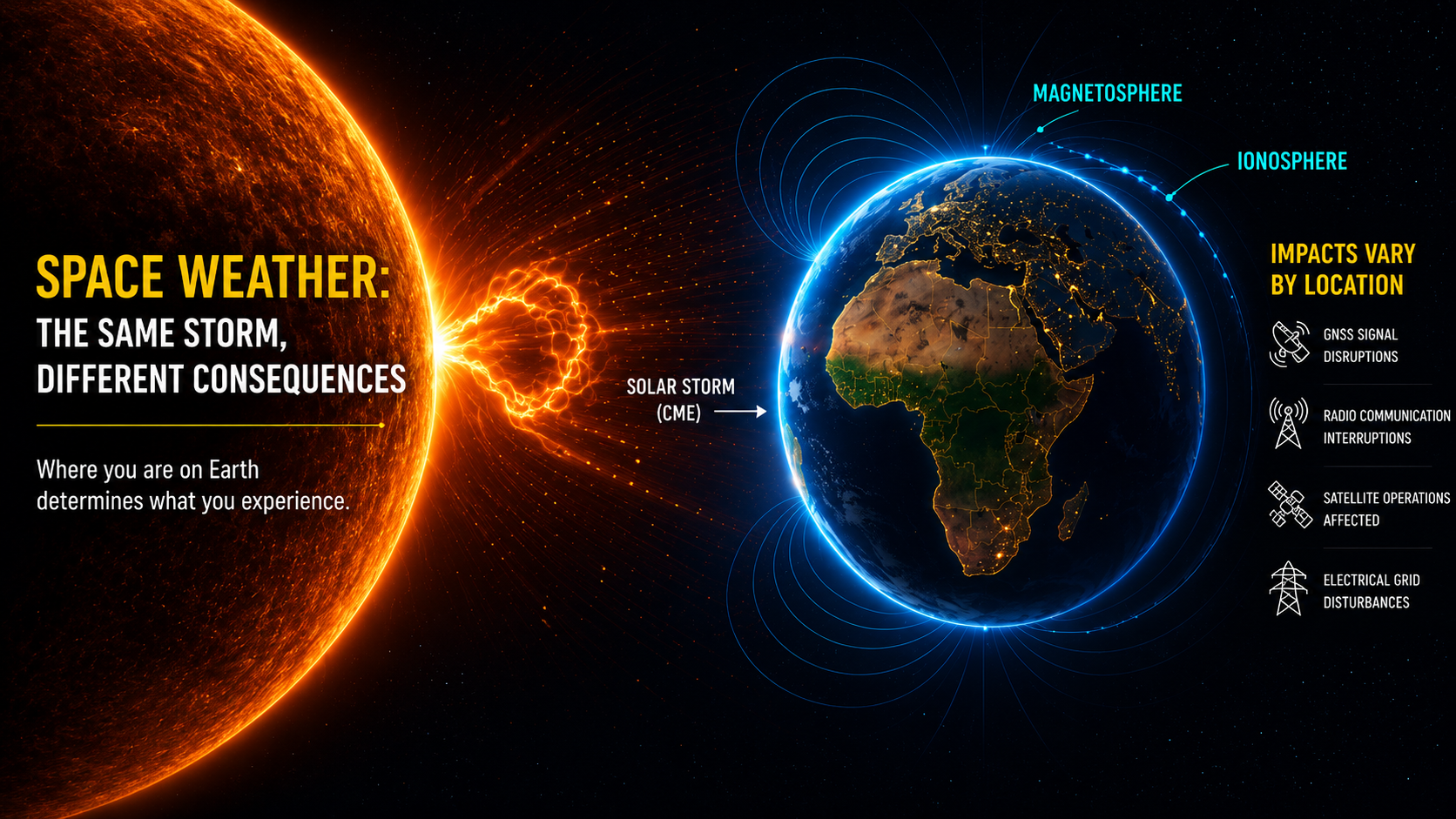
Space weather is a fascinating phenomenon. But what makes it particularly compelling, and particularly important, is that it does not affect every place on Earth the same way. Where you are on the planet determines what you experience when the Sun is active. This is not a coincidence. It is physics. The way space weather events interact with Earth depends on Earth's own properties: its magnetic field geometry, its atmospheric structure, its electrical environment. Those properties are not uniform. They change with geography. So the impact changes with geography too.
The Same Storm, Different Consequences
When a solar storm arrives at Earth, it does not affect every region the same way. The disturbances it drives into the ionosphere, (the layer of Earth's atmosphere capable of bending, delaying, and distorting satellite signals before they reach the ground) manifest differently across the planet. The interference it causes to radio systems, the errors it introduces into GPS positioning, the stress it places on satellite operations. All of these play out differently depending on where on Earth you are sitting. A GPS user in London and a GPS user in Nairobi during the same storm can have completely different experiences. The storm is the same. The location is not.
This has a direct and practical implication: you cannot monitor space weather impacts in one place by measuring them somewhere else. Understanding what a solar storm is doing to infrastructure in Africa requires instruments in Africa. Ground-based monitoring systems positioned across the continent, measuring the ionosphere as it actually behaves over African skies, in real time. This is what scientists call ground-based regional monitoring: observations collected at the location of interest, not inferred or extrapolated from stations sitting thousands of kilometres away. And because space weather impacts are geographically specific, no distant instrument can substitute for one that is actually there.
We cannot solve African space weather impacts with instruments based in America, Europe or Asia. The physics does not allow it.
Africa's Particular Exposure
This brings us to the second and perhaps more striking reason why space weather deserves serious attention in Africa: the continent's location is not ordinary.
A large portion of Africa sits within or immediately adjacent to the geomagnetic equatorial zone. The geomagnetic equator is not the same as the geographic equator. It is the line around the Earth where the planet's magnetic field runs perfectly horizontal, parallel to the surface. On either side of this line, stretching roughly 20 degrees north and south in magnetic latitude, lies the equatorial ionospheric region. This region behaves unlike anywhere else on Earth when space weather strikes.
The physics here is distinct. The near-horizontal magnetic field geometry at the equator drives electric fields and plasma dynamics in the ionosphere that produce phenomena not seen at higher latitudes. These include: Equatorial Plasma Bubbles, the Equatorial Ionization Anomaly, and intense ionospheric scintillation that causes satellite signals to fluctuate rapidly and unpredictably. These are not minor disturbances. They are significant, regular, and directly tied to solar activity. And they are most intense precisely over the African sector.
What this means is straightforward. Africa does not just experience space weather. It experiences some of the most intense and complex space weather effects on the planet, through mechanisms that are unique to its position. These are not the same problems Europe faces. They are not the same problems North America faces. They are Africa's own problems and they require Africa's own understanding, Africa's own data, and Africa's own solutions.
A Problem That Is Also an Opportunity
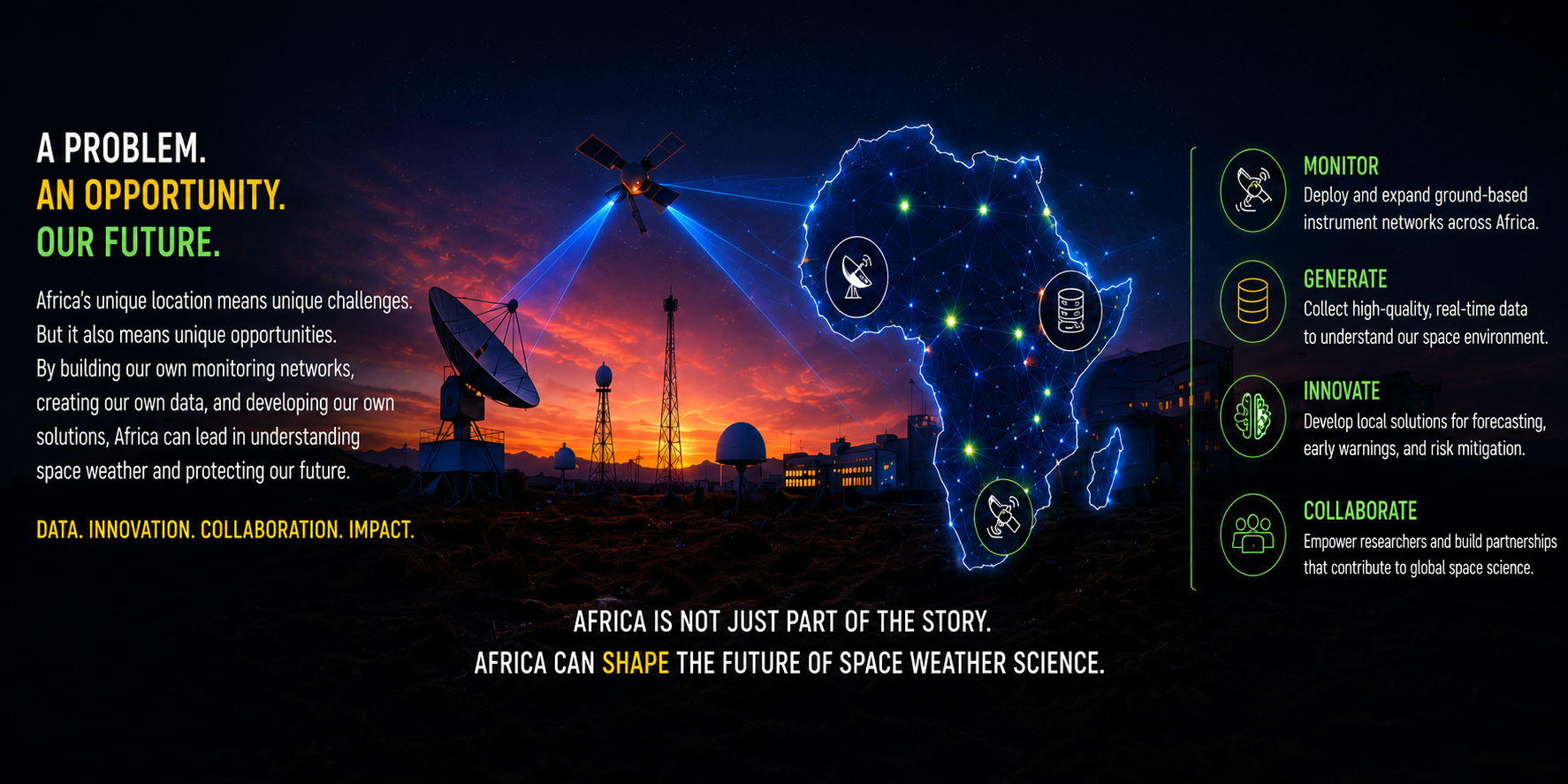
The case for space weather awareness in Africa is therefore not sentimental. It is scientific and it is practical. A continent building critical infrastructure on satellite-dependent technology, with a significant portion of its landmass sitting inside one of the most ionospherically active regions on Earth, and with historically sparse ground-based monitoring coverage. That is a continent with a great deal at stake.
But it is also a continent with a great deal to contribute. The African sector is one of the most scientifically undersampled regions in the world when it comes to space weather observations. Every instrument deployed here, every dataset collected, every analysis produced fills a gap that the global scientific community genuinely needs filled. African researchers working on this problem are not working on the margins of space weather science. They are working at its frontier.
That is why this conversation needs to happen here, in Africa, for Africa.