Solar Flare Effects on High Frequency (HF) Radio Communication

What is HF radio communication?
HF radio communication refers to communication that operates in the frequency range of 3 to 30 MHz of the radio frequency spectrum and remains one of the most widely used communication technologies on Earth. It is the link for aircraft crossing oceans, the safety channel for ships at sea, and the backbone of military field communications. While HF communication requires transmitters and receiving stations at both ends, it needs no cables, no relay towers, and no network infrastructure spanning the distance between them.
How the HF signal reaches a receiver across thousands of kilometres is not magic. It is made possible by a layer of the atmosphere extending between 60 and 1,000 kilometres above Earth's surface called the ionosphere. HF signals leaving their transmitter do not travel in a straight line to their destination. Instead, they travel upward, bounce off the ionosphere, return to Earth's surface, bounce upward again, and continue this skip pattern until the signal reaches a receiver at one of those ground or sea touchpoints. This makes the ionosphere not just useful to HF communication but the entire mechanism that enables it.
How exactly does the Ionosphere enable HF communication?
The ionosphere is not a single uniform layer. It is a stack of distinct regions, each with its own properties and effect on HF radio signals passing through it.
The lowest region is called the D layer and sits between roughly 60 and 90 kilometres above Earth's surface. Because of its proximity to Earth, it has very few electrons and a high concentration of neutral air molecules compared to other regions, giving it the lowest electron density of all ionospheric regions. Electron density is a key contributor to what is known as the critical frequency of a layer; this is the highest HF frequency a layer is able to reflect back towards Earth. At or below this frequency, the layer reflects the signal enabling HF communication. Above it, the signal passes through to the next layer that can reflect it, losing some energy in the process through absorption. Absorption is the process by which the signal's energy is taken up by the layer and converted to heat; the signal weakens but continues upward. The amount absorbed depends on the collision rate between electrons and neutral air molecules, which in turn depends on how dense the air is in that layer. The D layer's critical frequency falls below the HF range entirely, meaning it reflects no HF signals at all. Instead it allows them to pass through, partially absorbing their energy (more so at lower frequencies) due to its high collision rate driven by its relatively dense air. As you go higher through the ionosphere, absorption decreases and reflection becomes possible because the collision rate drops as the air thins.
Above the D layer sits the E layer, between approximately 90 and 150 kilometres. It has more electrons and a higher critical frequency than the D layer. Applying the same critical frequency concept, the E layer can reflect HF signals, though only at lower frequencies, enabling shorter distance communication in what operators call E layer propagation.
The most important region for long distance HF communication is the F layer, sitting between roughly 150 and 1,000 kilometres. It has the highest electron density of any ionospheric region and therefore the highest critical frequency, giving it the ability to reflect a wide range of HF frequencies across the longest distances. The reason behind its high electron density compared to the lower regions is that solar radiation reaches the F layer first, and at full intensity. It is therefore energetic enough to dislodge large numbers of electrons at that altitude. By the time that same radiation filters down to the D layer, much of its energy has already been spent, which is why lower layers end up with lower electron densities.
During daylight hours, the intense solar radiation maintains two distinct ionisation levels within the F region, splitting it into the F1 and F2 sub-layers. At night, without solar radiation sustaining that separation, the F1 weakens and merges with the F2 into a single F layer. The F2, and the merged nighttime F layer, is the primary reflecting surface for long distance HF communication. The electrons in the ionosphere are, essentially, the enablers of the entire HF propagation story.
How far can HF signals travel?
Three things determine how far each HF signal skip travels. The angle of transmission matters significantly: a signal fired at a shallow angle travels further before being reflected back, producing a longer skip, while a steeper angle produces a shorter one. A single skip can cover anywhere from a few hundred kilometres to around 4,000 kilometres depending on this angle and the reflecting layer involved.
The frequency used also plays a role. Higher HF frequencies penetrate deeper into the ionosphere before finding a layer with a high enough critical frequency to reflect them. This means they tend to travel further per skip. Lower frequencies are reflected sooner and produce shorter skips.
Finally, the ionosphere's electron density at that moment determines which frequencies can be reflected at all. A dense, well ionised F layer can reflect a wider range of frequencies, keeping more signals in play. A weakly ionised layer may let higher frequencies escape into space with no return. This matters for distance because if a frequency cannot be reflected, there is no skip at all regardless of the angle.
This is why HF operators adjust their frequencies throughout the day and night. During the day, the F layer sustains higher electron density, meaning its critical frequency is higher and it can reflect a wider range of HF frequencies. At night, electron density drops and operators shift to lower frequencies that the weaker nighttime ionosphere can still reflect.
Each ground bounce in the skip pattern costs the signal some energy. Seawater reflects better than dry land, and rocky terrain better than dense forest. Signals arriving after many skips across a long path are weaker than those arriving after fewer. A denser, more stable ionosphere helps here not by extending distance but by reducing the energy lost at each ionospheric reflection; what is technically called the signal's integrity, or more precisely its signal strength. A cleaner, stronger reflection means less degradation per hop.
How do Solar Flares affect HF communication?
Every space weather event that reaches Earth interacts with the ionosphere in some way. The ionosphere is the common thread. But different space weather events disturb it through different mechanisms, at different speeds, with different consequences for HF communication. Of all space weather events, solar flares produce the most sudden and operationally devastating effect on HF communication.
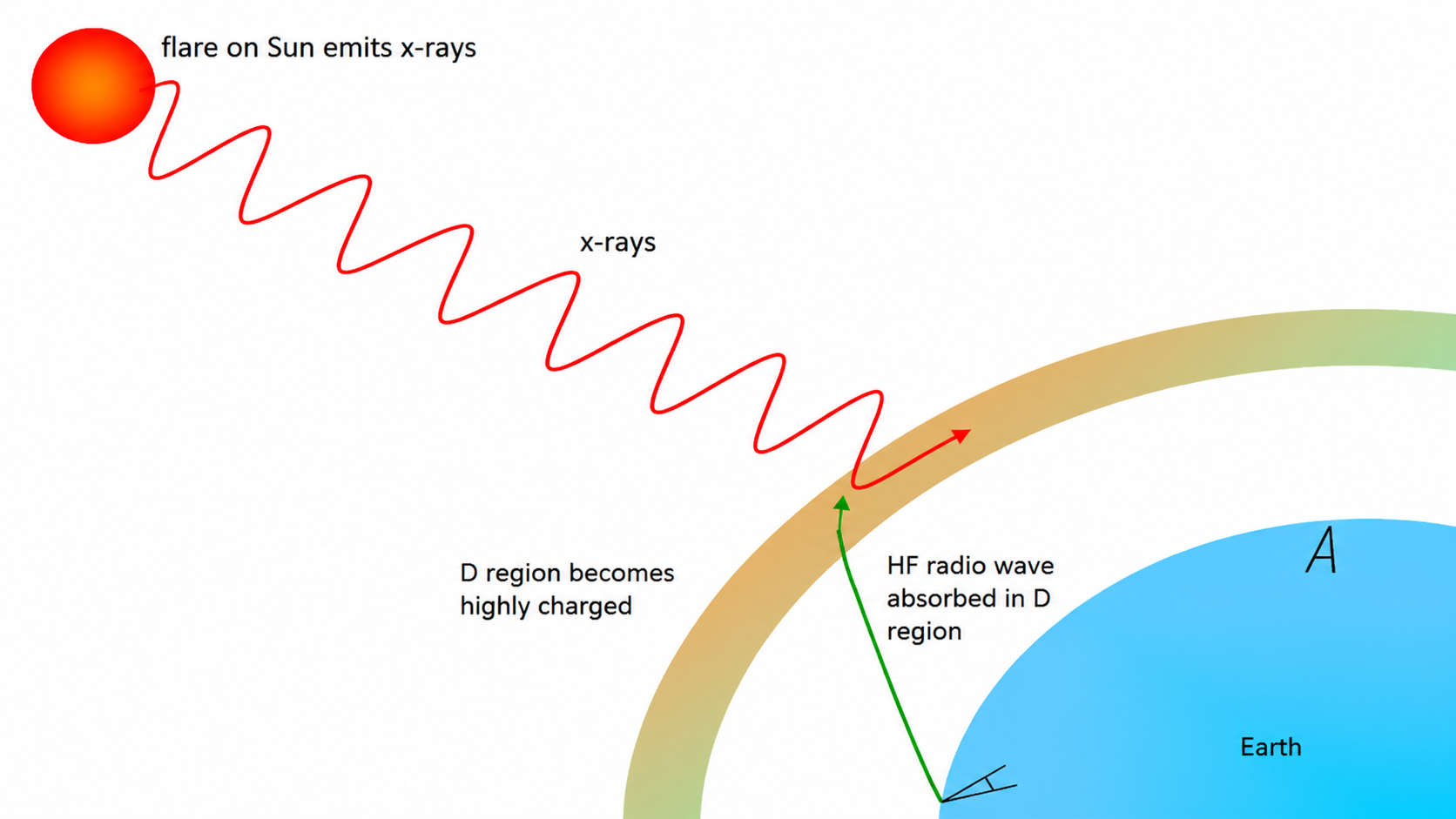
A solar flare releases an intense burst of X-ray and extreme ultraviolet radiation. This radiation travels at the speed of light and covers the 150 million kilometres between the Sun and Earth in approximately eight minutes. When it arrives, it strikes the sunlit side of the ionosphere and dramatically over-ionises the D layer.
Under normal daytime conditions, the D layer absorbs some HF energy but allows enough through for the signal to reach the reflecting E and F layers above and return to Earth; which is manageable, and accounted for by operators. But when a solar flare's X-ray radiation hits, the D layer becomes so densely ionised that its already high collision rate intensifies further, causing it to absorb HF frequencies that would normally penetrate through to the F layer. The signal goes in. It does not come out. This is called a Shortwave Radio Fadeout, and it affects the entire sunlit side of the world simultaneously. When signal frequency is high enough relative to the collision rate in the D layer, absorption decreases; which is why higher HF frequencies survive solar flare conditions better than lower ones, though even they are not immune during major events.
The onset is immediate. An HF circuit that was operating normally goes silent within minutes of the flare's radiation arriving. There is no gradual degradation. The disruption is sudden and covers vast geographic areas at once.
What determines which frequencies are affected and for how long is the magnitude classification of the flare. Solar flares are classified from A and B at the weakest through C, M, and X at the strongest, with each class corresponding directly to the intensity of X-ray output. An X-class flare drives D layer ionisation far beyond what a moderate flare achieves. During a major X-class event, HF blackouts on the sunlit hemisphere can last several hours, with lower HF frequencies remaining suppressed the longest as the ionosphere slowly recovers.
One notable characteristic of solar flare effects on HF is that they are confined to the sunlit side of Earth. The flare's radiation only disturbs the ionosphere it can directly illuminate. On the night side, the D layer is too thin and weakly ionised to cause significant absorption; and it is not only the D layer that behaves differently at night, as the E and lower F regions also weaken considerably without solar radiation sustaining them. HF communication on night side paths continues, subject to the normal nighttime electron density conditions and any other space weather events that affect the ionosphere regardless of solar illumination. Operators who can route their signals through night side paths during a flare event may find those circuits remain usable.