Space Situational Awareness (SSA): From Science to Instrumentation

What Is Space Situational Awareness?
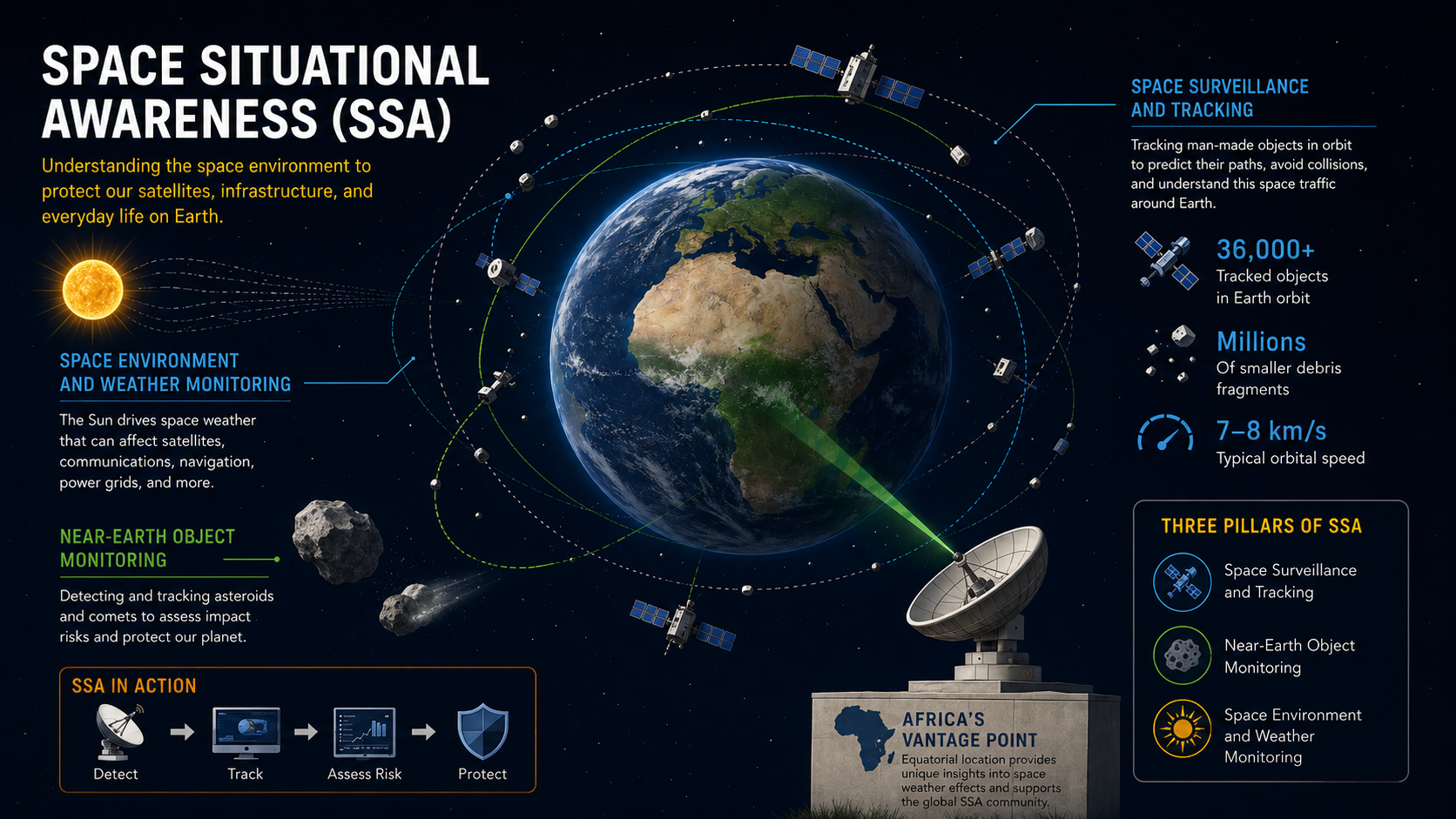
Space Situational Awareness, commonly referred to as SSA, is the continuous knowledge and understanding of the space environment. It covers the detection, tracking, and characterisation of artificial orbital objects, natural bodies, and environmental conditions that affect the safety and sustainability of space operations. SSA is not a single activity. It is a framework built around three interconnected segments: space surveillance and tracking, near-Earth object monitoring, and space environment and weather monitoring. Each one exists because a specific category of risk demands it.
Space Surveillance and Tracking
The first segment is about knowing what humanity has put into orbit, where it is, and where it is going. This sounds manageable until you look at the numbers. There are currently more than 36,000 tracked objects in Earth orbit according to the U.S. Space Command Space-Track Database. These include active satellites, defunct spacecraft, spent rocket bodies, and debris fragments produced by collisions and explosions in orbit. That number only accounts for objects large enough to be detected by current tracking systems. Smaller fragments, numbering in the millions, remain largely untracked. Every one of them is travelling at orbital velocities of roughly 7 to 8 kilometres per second. At those speeds, even a fragment the size of a marble carries enough kinetic energy to cause catastrophic damage to an operational satellite.
Space debris is a core part of this segment. Once a satellite reaches the end of its operational life, or once a rocket has delivered its payload and been discarded, there is no one at the controls anymore. Responsible operators are required to design re-entry trajectories that bring debris down over open ocean, and most do. But when a rocket stage fails to complete its de-orbit manoeuvre, or when a defunct satellite decays naturally over years, no one is choosing where it lands anymore. They simply continue following their orbital paths, governed entirely by physics, until atmospheric drag gradually pulls them lower and lower until they eventually fall back toward Earth. Tracking this population, predicting when and where objects will re-enter the atmosphere, and assessing the risk to people and infrastructure on the ground is a growing and urgent responsibility.
The practical output of all this tracking is something called conjunction analysis. A conjunction is when two objects in orbit are calculated to pass close enough to each other that a collision becomes possible. When that happens, operators of the active satellite receive a warning with enough lead time to fire their thrusters and move out of the way. The analysis itself is the continuous background work of computing all possible close approaches across tens of thousands of tracked objects and flagging the ones that cross a risk threshold. It is now a routine part of operating any satellite in low Earth orbit, and it is becoming more demanding every year as the orbital environment grows more congested.
Near-Earth Object Monitoring
The second segment shifts focus from what we launched to what nature has placed in our cosmic neighbourhood. Near-Earth objects, primarily asteroids whose orbits bring them into proximity with Earth, represent a hazard that operates on much longer timescales but with potentially far larger consequences. This work falls under what is globally referred to as planetary defence.
The approach is systematic. Dedicated sky survey programmes such as NASA's Catalina Sky Survey and the Pan-STARRS telescope network in Hawaii scan the sky continuously, cataloguing newly discovered asteroids, refining their orbital parameters, and computing impact probabilities over decades and centuries ahead. Most objects, once characterised, are ruled out as threats. The work is patient and methodical, the kind that produces no headlines for years at a time. The point is to have enough warning, ideally decades, so that if an object does pose a genuine risk, there is time to act. Planetary defence missions like NASA's DART, which successfully altered an asteroid's trajectory in 2022, have already demonstrated that acting on that warning is within humanity's capability.
Space Environment and Weather Monitoring
The third segment is the one that connects space most directly to daily life on the ground. The Sun continuously influences the space environment through solar wind, solar flares, and coronal mass ejections. These events affect satellite operations, degrade GPS accuracy, disrupt HF radio communications used by aviation and emergency services, and in extreme cases drive electrical currents into power grids. Space weather is not a peripheral concern. It is one of SSA's core components, because understanding the environment that satellites operate in is inseparable from understanding the risks they face.
More details on how space weather works, what it affects, and how it is monitored can be found in the section titled: What Is Space Weather?
The Instruments Behind SSA
Each SSA segment runs on a specific set of instruments, and understanding what they measure helps connect science to impacts.
For space surveillance and tracking, the primary instruments are radar systems, both mechanical and phased-array, that detect objects in low Earth orbit by bouncing radio waves off them and measuring the return signal. This tells operators where an object is and how fast it is moving, which is the raw data that feeds conjunction analysis and re-entry prediction. Optical telescopes, particularly wide-field systems that can survey large portions of sky quickly, extend that coverage to higher orbits where radar reach is limited. Radio frequency monitoring equipment listens for signals emitted by active satellites, and anomalies in those signals can indicate a satellite is tumbling, degrading, or no longer under control before any visual confirmation is possible.
For near-Earth object monitoring, the instruments are wide-field optical telescopes equipped with large mosaic detectors capable of imaging vast areas of sky in a single night. Programmes like the Catalina Sky Survey and Pan-STARRS were built specifically for this work. Spectroscopic instruments go a step further, analysing the light reflected off a newly discovered asteroid to determine its composition, which matters because a rocky object and a metallic one of the same size behave very differently under deflection scenarios.
For space weather monitoring, the instrument suite is broader and more distributed, which reflects the fact that space weather effects show up across many systems simultaneously. Magnetometers measure variations in Earth's magnetic field caused by solar activity. A sudden shift in the magnetometer reading is often the first ground-level signature that a geomagnetic storm is underway, the same kind of storm that can push electrical surges into power grid infrastructure. Ionosondes send radio pulses vertically into the ionosphere and measure the reflected signals to map its structure in real time. When the ionosphere is disturbed, HF radio communications used by aviation and emergency services degrade or fail entirely, and the ionosonde is what tells you that is happening and how severe it is. GNSS receivers compute the delay that ionospheric disturbances introduce into satellite navigation signals. That delay is what causes GPS positioning errors during active space weather periods, errors that affect everything from aircraft approaches to precision agriculture to survey work. Riometers measure the absorption of cosmic radio noise in the ionosphere, which increases when energetic particles from solar events rain into the upper atmosphere, providing an early indicator of conditions that stress satellite systems in low Earth orbit. RF spectrum monitoring equipment tracks how space weather affects radio signal propagation across frequencies, giving real-time visibility into conditions that would otherwise only become apparent when a communication link degrades or fails.
Together these instruments do not just observe the space environment. They connect what is happening at the Sun and in orbit to what is felt on the ground, in cockpits, on farms, and inside power stations. That connection is what makes SSA operational rather than purely academic.