Daily Space Weather Bulletin, 4 November 2026

Daily Space Weather Bulletin
Issued: 04 November 2026, 13:00 UTC
Issued by: Space Weather Africa
Valid for: Next 24 hours
Solar activity was very low over the past 24 hours, with three numbered sunspot regions on the disk and no significant flares. The geomagnetic field has been quiet for the past 24 hours, with solar wind speed peaking at about 476 km/s on 3 November. Quiet conditions are expected on 4 and 6 November, with a chance of quiet to active conditions on 5 November. M-class flares are possible on all three days (25% daily), with a slight chance of an X-class flare. Over East Africa, total electron content was near the monthly median and scintillation after sunset was weak.
Overall status: QUIET
Current images of the Sun from the Solar Dynamics Observatory (SDO). Each filter shows a different layer of the Sun, so the same disk looks different in each panel.
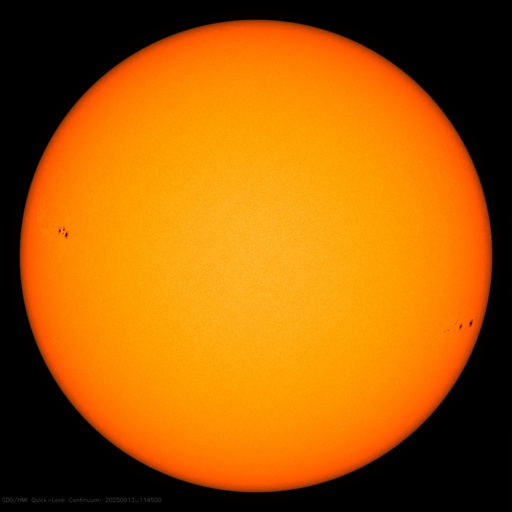
The Sun's surface as the eye would see it. Dark patches are sunspots, where strong magnetic fields suppress heat. Sunspot regions are the usual source of solar flares.
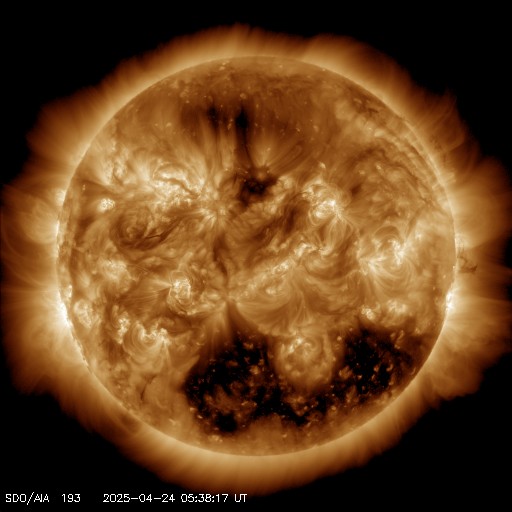
The hot outer atmosphere (corona). Large dark areas are coronal holes, which release fast solar wind and can cause geomagnetic activity at Earth a few days later.
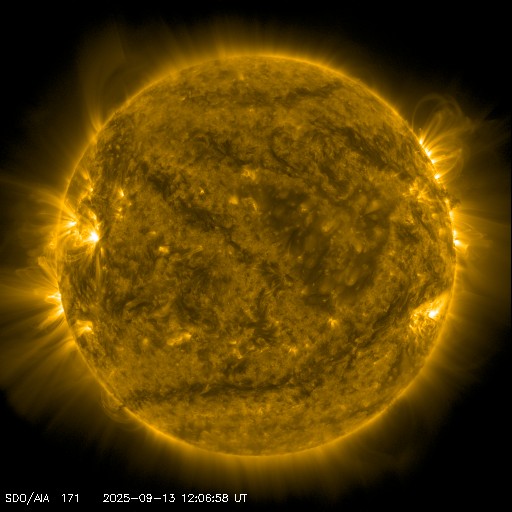
The quiet corona. Bright arcs are magnetic loops above active regions, so this panel shows where the magnetic field is most complex.
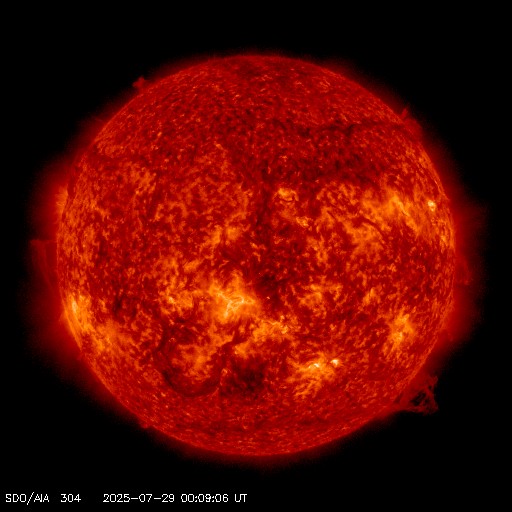
The chromosphere, the layer below the corona. Bright patches mark active regions and flare sites, and material rising off the edge of the disk is a prominence.
Seen today: 3 numbered sunspot regions on the disk: AR4564, AR4565 and AR4566 (as at 3 Nov). Coronal holes: a southern hemisphere hole near the central meridian, the likely source of the waning high-speed stream.
Image credit: Courtesy of NASA/SDO. Images update automatically every few minutes; click any image to open the SDO data page.
| Status | VERY LOW |
|---|---|
| Flares seen |
No M or X class flares. No noteworthy flares were detected in the past 72 hours. Most recent small events: B7 at 06:08 UTC on 2 Nov; C1.1 from AR4564, peak 12:36 UTC on 1 Nov. None reported since 22:00 UTC on 3 Nov. |
| Sunspot regions on the disk | 3: AR4564, AR4565, AR4566 |
| Sunspot number | 30 (as at 2 Nov 2026) |
| F10.7 radio flux | 100 sfu (observed 3 Nov, 90-day mean 109) |
| Coronal mass ejections | None observed |
| Speed | Peaked at 476 km/s at 06:30 UTC on 3 Nov, near normal levels |
|---|---|
| Density | About 6.4 p/cm³ (2 Nov) |
| IMF Bt | Peak 6 nT at 02:03 UTC on 3 Nov |
| IMF Bz | Maximum southward Bz of -4 nT at 05:59 UTC on 3 Nov; no strong southward Bz |
| Coronal holes | Solar wind has returned to near-normal levels after the high-speed stream of 1 Nov |
| Status | QUIET |
|---|---|
| Kp (max, last 24 h) | 2 |
| Storm level (G-scale) | None (G0) |
| Dst index (global) | -11 nT at 03:00 UTC on 4 Nov (lowest in the last 24 h) |
| Local magnetometer | Nairobi station: quiet, horizontal component varied by about 22 nT over the last 24 h |
| Total electron content (TECU), 12:00 UTC | |
|---|---|
| Kenya | |
| Nairobi | 38.2 |
| Malindi | 41.5 |
| Ethiopia | |
| Addis Ababa | 35.9 |
| Uganda | |
| Kampala | 40.1 |
| Median / mean | 39.2 / 38.9 (near monthly median) |
| Scintillation (S4), maximum during the night of 3 Nov | |
|---|---|
| Kenya | |
| Nairobi | 0.21 at 16:50 UTC |
| Malindi | 0.28 at 17:20 UTC |
| Ethiopia | |
| Addis Ababa | 0.18 at 16:40 UTC |
| Uganda | |
| Kampala | 0.24 at 17:10 UTC |
| Median / mean | 0.23 / 0.23 (weak) |
| foF2 (MHz) and HF conditions, 12:00 UTC | |
|---|---|
| Kenya | |
| Nairobi | 9.8 MHz. Normal |
| Malindi | 10.4 MHz. Normal |
| Ethiopia | |
| Addis Ababa | 9.5 MHz. Normal |
| Uganda | |
| Kampala | 10.2 MHz. Normal |
| Median / mean | 10.0 / 10.0 MHz. Normal HF conditions |
| GNSS impact | |
|---|---|
| Kenya | |
| Nairobi | No significant impact |
| Malindi | Brief weak degradation of single-frequency positioning after sunset |
| Ethiopia | |
| Addis Ababa | No significant impact |
| Uganda | |
| Kampala | Brief weak degradation of single-frequency positioning after sunset |
| Overall | Minor, limited to brief weak scintillation after sunset |
| HF radio impact | |
|---|---|
| No significant blackout. Normal propagation, with lower HF frequencies best after sunset. |
Based on observations from the Space Weather Africa GNSS receiver network and the Malindi ionosonde. Example values shown.
| Proton flux (≥10 MeV) | No enhancement (event probability 5%) |
|---|---|
| Radiation storm (S-scale) | None (S0) |
| Electron flux (≥2 MeV) | Peaked at 4077 pfu at 16:20 UTC on 3 Nov. Elevated, with high levels expected through 5 Nov |
Flares are ranked by their peak X-ray flux measured by the GOES satellites. Each letter is ten times stronger than the one before it, and the number gives the strength within the class (an M5 is five times an M1).
| Class | Peak flux (W/m²) | NOAA scale | Typical impact |
|---|---|---|---|
| A, B | Below 10⁻⁶ | None | Background level. No impact. |
| C | 10⁻⁶ to 10⁻⁵ | None | Small flare. No significant impact on Earth. |
| M1 to M4 | 10⁻⁵ to 5×10⁻⁵ | R1 (Minor) | Weak or minor degradation of HF radio on the sunlit side, with occasional loss of contact. Low frequency navigation signals degraded for brief intervals. |
| M5 to M9 | 5×10⁻⁵ to 10⁻⁴ | R2 (Moderate) | Limited HF radio blackout on the sunlit side, with loss of contact for tens of minutes. Low frequency navigation degraded for tens of minutes. |
| X1 to X9 | 10⁻⁴ to 10⁻³ | R3 (Strong) | Wide area HF blackout, with loss of contact for about an hour on the sunlit side. Low frequency navigation degraded for about an hour. |
| X10 to X19 | 10⁻³ to 2×10⁻³ | R4 (Severe) | HF blackout on most of the sunlit side for one to two hours. Navigation outages and minor satellite navigation disruption possible. |
| X20 and above | 2×10⁻³ and above | R5 (Extreme) | Complete HF blackout on the entire sunlit side for several hours. Navigation outages and positioning errors for several hours. |
Impacts apply to the daylight side of Earth, so over Africa they occur while the Sun is up. Large flares can also be followed by coronal mass ejections (CMEs) and geomagnetic storms. Scale source: NOAA Space Weather Prediction Center.
Shows flare strength over the last few days, with flare classes A, B, C, M and X on the right axis. A peak reaching the M or X line marks a flare of that class. Source: NOAA SWPC, GOES primary satellite.
Click a link to open the full interactive dashboard on live.spaceweather.africa. All dashboards: live.spaceweather.africa
Source: Malindi Ionosonde. Ionosonde-derived HF propagation conditions over Malindi.
Source: GOES 18 & 19 satellites. Predicted D-region absorption of HF signals.
Source: GNSS receiver network. TEC measured across the GNSS receiver network.
Source: GNSS receiver network. Amplitude scintillation, showing signal fading.
Source: GNSS receiver network. Phase scintillation, showing rapid phase fluctuations.
Source: TART telescope. Solar radio bursts detected by the TART telescope.
GOES X-ray flux and other NOAA plots: swpc.noaa.gov/products/goes-x-ray-flux
| 4 Nov | 5 Nov | 6 Nov | |
|---|---|---|---|
| M-class flare probability | 25% | 25% | 25% |
| X-class flare probability | 10% | 10% | 10% |
| Expected Kp (max) | 1 to 2 | 3 to 4 | 1 to 2 |
| Ionospheric disturbance | Low | Low to moderate | Low |
Sources: Space Weather Africa GNSS receiver network; Electronic Space Weather Upper Atmosphere (eSWua); NOAA SWPC joint USAF/NOAA report; SpaceWeather.com; EarthSky and SolarHam; NASA/SDO imagery.
Disclaimer: This bulletin is for information and educational use. Space weather conditions can change quickly. It should not be the only basis for operational or safety decisions. Last updated: 04 November 2026, 13:00 UTC.